
Carbon Footprint Consultancy Services help businesses measure greenhouse gas emissions, improve environmental performance, and develop effective decarbonization strategies. As climate-related expectations continue to grow, companies need transparent emissions data to demonstrate environmental responsibility and support their sustainability commitments.
Without proper technical guidance, carbon footprint assessments can become challenging. Businesses must collect activity data, select appropriate emission factors, identify relevant emissions sources, and prepare reliable documentation for internal reviews or external verification.
PT Actia Bersama Sejahtera provides professional Carbon Footprint Consultancy Services in Indonesia. By combining technical expertise, greenhouse gas accounting methodologies, and digital carbon management solutions, Actia helps organizations understand their emissions profiles and develop measurable improvement strategies.
Our approach supports corporate greenhouse gas inventories, carbon footprint calculations, sustainability reporting, Science Based Targets initiative (SBTi) advisory, product life cycle assessments, and long-term decarbonization planning.
Table of Contents
- Why Carbon Footprint Consultancy Matters
- GHG Inventory Methodology
- 8 Key Carbon Footprint Consultancy Solutions
- Importance of Carbon Calculation Software
- SBTi Advisory and ESG Consultancy
- Life Cycle Assessment for Products
- Carbon Economy Training
- Environmental Monitoring Equipment
- Why Choose Actia Climate?
- Frequently Asked Questions
- Contact Actia Climate
Why Carbon Footprint Consultancy Services Matter for Modern Businesses
Growing awareness of climate change and environmental responsibility has transformed how companies operate in Indonesia and international markets. Corporate carbon footprint assessments are increasingly important for business competitiveness, sustainability reporting, and supply-chain transparency.
Investors, customers, and business partners may consider environmental performance when evaluating potential business relationships. Companies that understand their greenhouse gas emissions are better positioned to communicate their environmental commitments and identify opportunities for improvement.
Carbon Footprint Consultancy Services provide technical assistance in measuring emissions and evaluating climate-related business risks. Professional guidance helps companies establish a consistent accounting methodology and produce more reliable environmental information.
Regulatory developments also influence corporate emissions management. In Indonesia, greenhouse gas reporting and carbon-related requirements apply differently across industries and regulated activities. Businesses should evaluate the obligations relevant to their operations rather than assuming that all companies must follow identical reporting procedures.
By developing a structured carbon management process, organizations can improve operational transparency, strengthen sustainability planning, and prepare for changing market expectations.
Implementing a Standardized Greenhouse Gas Inventory
A greenhouse gas inventory is a systematic assessment of emissions associated with an organization’s activities during a defined reporting period.
Reliable inventories require appropriate methodologies, supporting evidence, and clearly defined organizational and operational boundaries. Widely recognized references include the GHG Protocol and ISO 14064-1.
The process typically begins by identifying emissions sources, determining the reporting boundary, collecting activity data, selecting appropriate emission factors, and calculating emissions in carbon dioxide equivalent (CO2e).
Understanding Scope 1, Scope 2, and Scope 3 Emissions
- Scope 1 – Direct Emissions: Greenhouse gas emissions from sources owned or controlled by the organization, including fuel combustion in vehicles, industrial machinery, and other equipment.
- Scope 2 – Energy-Related Indirect Emissions: Emissions associated with purchased electricity, steam, heating, and cooling consumed by the organization.
- Scope 3 – Other Indirect Emissions: Emissions associated with other activities in the value chain, including purchased materials, transportation, business travel, waste, and relevant product life-cycle activities.
Understanding these categories enables management teams to identify important emissions sources and determine appropriate reduction priorities.
Accurate documentation is also essential for internal review and independent verification. Historical emissions data, transparent calculation assumptions, and traceable supporting records help organizations explain how their reported results were produced.
Our Carbon Footprint Consultancy Services support companies throughout the inventory process, from initial data collection to the preparation of technical documentation.
8 Key Carbon Footprint Consultancy Services and Solutions
Actia Climate offers an integrated range of carbon management solutions. These services are designed to help organizations assess their emissions, improve reporting processes, and identify practical opportunities for decarbonization.
1. Carbon Footprint Calculation Platform
Actia’s digital carbon footprint calculation platform is designed to simplify greenhouse gas accounting for organizations and individual users.
The platform uses emission factor references to support the calculation of greenhouse gas emissions from relevant activities. It helps companies organize emissions information and identify areas that may require additional attention.
- Access comprehensive emission factor references for personal and industrial activities.
- Support calculations covering Scope 1, Scope 2, and relevant Scope 3 emissions.
- Identify high-emission activities and carbon hotspots for improvement planning.
- Organize information that can support sustainability disclosures and reporting.
- Analyze activity data and prepare structured outputs for technical review.
Digital carbon accounting can help businesses improve the consistency and efficiency of their emissions data management.
2. CO2 Emissions Tracking and Reduction Monitoring
Effective emissions management requires continuous evaluation rather than a one-time calculation. Monitoring emissions over multiple reporting periods helps companies understand performance trends and evaluate reduction initiatives.
Our Carbon Footprint Consultancy Services support the development of practical emissions monitoring approaches based on organizational needs and available information.
- Identify major emissions sources associated with daily business operations.
- Evaluate the effectiveness of implemented emissions mitigation measures.
- Analyze operational practices that may contribute to excessive energy consumption.
- Maintain historical emissions records for internal reviews and external assessments.
- Identify unexpected emissions increases that may require investigation.
Consistent emissions tracking can help management teams determine whether implemented initiatives are achieving the expected environmental results.
3. Sustainability Reporting, GHG Inventory, SBTi, and CDP Support
Reliable environmental reporting is essential for communicating sustainability performance to investors, customers, regulators, and other stakeholders.
Actia supports organizations in transforming greenhouse gas accounting information into structured sustainability reporting materials.
- Prepare sustainability reporting information using relevant frameworks such as the Global Reporting Initiative (GRI).
- Organize data for CDP environmental disclosures and related reporting requirements.
- Support SBTi target-setting preparation and associated technical documentation.
- Develop greenhouse gas inventory reports using recognized accounting methodologies.
- Present environmental performance information through clear tables, charts, and supporting explanations.
The specific reporting framework should be selected according to the organization’s legal obligations, stakeholder expectations, and sustainability objectives.
4. Corporate Decarbonization Strategy and Net-Zero Roadmap
After establishing a reliable emissions baseline, companies can begin developing a strategy for reducing greenhouse gas emissions over time.
Carbon Footprint Consultancy Services can help organizations evaluate available reduction opportunities, identify implementation priorities, and develop a structured roadmap toward long-term climate objectives.
- Establish an appropriate baseline year for measuring future emissions performance.
- Develop short-term, medium-term, and long-term decarbonization objectives.
- Assess low-carbon technologies suited to the organization’s operational characteristics.
- Support coordination with relevant environmental technology providers.
- Evaluate the technical and financial feasibility of proposed mitigation measures.
Decarbonization initiatives may include energy efficiency improvements, process optimization, renewable energy adoption, and better resource management.
A realistic roadmap should consider operational requirements, implementation costs, expected emissions reductions, and management responsibilities.
5. Greenhouse Gas Inventory Consultancy
Actia provides greenhouse gas inventory assistance for organizations operating across manufacturing, energy, service, and other business sectors.
The objective is to produce consistent emissions information using appropriate calculation methods and supporting data.
- Assist with the collection of primary and secondary emissions-related data.
- Select calculation approaches appropriate for industry-specific activities.
- Identify significant emissions sources and potential reduction opportunities.
- Prepare technical documentation using applicable greenhouse gas accounting standards.
- Support the organization of information for independent verification where required.
- Apply appropriate confidentiality practices when handling business information.
ISO 14064-3:2019 provides requirements and guidance for the verification and validation of greenhouse gas statements. Independent assurance or verification, when required, must be performed by an appropriately qualified verification body.
For additional information, explore this greenhouse gas inventory service reference.
6. Product Carbon Footprint Reporting
Product carbon footprint assessments help businesses understand greenhouse gas emissions associated with the production and life cycle of a particular product.
These assessments are particularly relevant for manufacturers, exporters, and organizations that receive requests for environmental product information from international customers.
- Calculate emissions associated with raw material sourcing, production, transportation, product use, and end-of-life stages.
- Prepare product emissions information for relevant stakeholders and business partners.
- Identify opportunities for improving manufacturing energy efficiency.
- Support product improvement initiatives based on life-cycle assessment results.
- Develop supporting documentation for evidence-based sustainability claims.
Product carbon footprint calculations can follow recognized methodologies such as ISO 14067, while broader environmental Life Cycle Assessment studies may use ISO 14040 and ISO 14044.
Credible assessment results can help businesses make more informed decisions about materials, production processes, and environmental product communications.
7. Carbon Economy Training and Capacity Building
Successful emissions management depends on employees who understand the principles of greenhouse gas accounting, climate-related regulations, and sustainable business practices.
Actia provides training programs to strengthen internal capabilities and improve organizational readiness.
- Training on carbon pricing, carbon markets, and carbon economic value mechanisms.
- Technical guidance on greenhouse gas accounting and emissions calculation methods.
- Introduction to relevant Indonesian carbon management regulations.
- Practical workshops for developing emissions reduction initiatives.
- Capacity building for environmental teams, sustainability professionals, and management personnel.
Organizations can explore available programs through Actia Climate’s professional training programs.
8. Environmental Monitoring Equipment Sales and Rental
In addition to Carbon Footprint Consultancy Services, Actia offers environmental monitoring equipment solutions for industrial, commercial, and environmental assessment activities.
Appropriate monitoring instruments help organizations measure selected ambient air pollutants and evaluate air quality conditions in relevant locations.
- Sales and rental support for portable ambient air quality monitoring equipment.
- Availability of Aeroqual S500 instruments for applicable monitoring needs.
- Options for measuring selected gas pollutants using compatible sensors.
- Technical guidance concerning equipment operation and calibration.
- Support for environmental monitoring activities at industrial sites.
Ambient air quality monitoring and corporate greenhouse gas accounting are different environmental assessment activities. Air quality measurements should not be treated as a replacement for a properly prepared greenhouse gas inventory.
The Importance of Carbon Footprint Calculation Software
Digital transformation has created opportunities for companies to improve the way they collect, process, and manage environmental information.
Traditional spreadsheet-based emissions calculations can become difficult to maintain when data comes from multiple facilities, departments, or business units.
Using carbon footprint calculation software can help organizations standardize data collection, reduce repetitive administrative work, and improve consistency across reporting periods.
Within Carbon Footprint Consultancy Services, digital tools can complement technical expertise by supporting the preparation and organization of emissions information.
For example, companies may use a structured platform to review electricity consumption, fuel use, transportation activities, and other relevant sources of greenhouse gas emissions.
When activity data is complete and appropriately validated, digital calculations can support management reviews and more efficient preparation of emissions reporting information.
However, software does not automatically guarantee accurate results. Reliable carbon accounting still requires appropriate emission factors, consistent reporting boundaries, and proper review of the underlying data.
SBTi Advisory Services and ESG Consultancy in Indonesia
Environmental, Social, and Governance (ESG) considerations are increasingly relevant to corporate strategy, business risk management, and sustainability reporting.
Actia’s Carbon Footprint Consultancy Services can support the environmental component of ESG programs by helping organizations establish reliable emissions data and develop appropriate climate-related objectives.
One important area is advisory support for the Science Based Targets initiative (SBTi).
The SBTi provides standards and guidance for companies seeking to establish greenhouse gas emissions reduction targets informed by climate science.
Actia can assist organizations in reviewing existing emissions data, identifying information gaps, preparing relevant technical documentation, and evaluating possible emissions reduction pathways.
Professional advisory support may include:
- Reviewing corporate greenhouse gas inventory completeness and calculation methods.
- Evaluating potential near-term and long-term emissions reduction targets.
- Preparing supporting information for applicable SBTi target submissions.
- Developing action plans to support the achievement of climate objectives.
- Improving internal understanding of ESG performance and environmental disclosure requirements.
Formal validation of science-based targets is subject to the requirements and assessment process established by the relevant SBTi validation body.
By connecting credible emissions data with practical improvement strategies, businesses can strengthen their approach to climate-related management and stakeholder communication.
Life Cycle Assessment (LCA) for Sustainable Products
A Life Cycle Assessment (LCA) evaluates environmental impacts associated with a product or service across defined stages of its life cycle.
The assessment may consider raw material extraction, manufacturing, transportation, product use, and final disposal or recycling.
Unlike an assessment focused exclusively on greenhouse gas emissions, a broader LCA can examine several environmental impact categories, including climate change, resource use, and other relevant environmental indicators.
Product-focused Carbon Footprint Consultancy Services help businesses understand the greenhouse gas emissions associated with these activities and identify opportunities to improve product performance.
For manufacturers, LCA information can support decisions about raw material selection, production efficiency, packaging, transportation, and end-of-life management.
Companies may also use appropriately verified assessment information to support certain environmental product declarations or certification processes, depending on the applicable scheme.
However, completing an LCA does not automatically qualify a product for an ecolabel or establish that it is environmentally superior. Such claims must be supported by relevant evidence and the requirements of the specific certification or disclosure program.
Using appropriate assessment methods, companies can identify product improvement opportunities and communicate environmental information more responsibly.
Carbon Economy Training and Professional Capacity Development
The transition toward a low-carbon economy requires professionals who understand the technical, regulatory, and financial aspects of greenhouse gas management.
Carbon economy training helps employees and management teams understand carbon accounting principles, relevant policy developments, and opportunities for business improvement.
Actia provides training programs designed around organizational needs, covering introductory concepts and more specialized technical topics.
Training subjects may include carbon pricing, emissions trading mechanisms, greenhouse gas inventory preparation, carbon accounting tools, and corporate decarbonization planning.
Practical learning activities can also help participants understand how to interpret emissions results and develop appropriate internal reduction initiatives.
By strengthening internal capabilities, businesses can improve the continuity of their carbon management programs and reduce unnecessary dependence on external assistance for routine activities.
Learn more about available topics through our carbon economy and greenhouse gas training programs.
Ambient Air Quality Monitoring Equipment: Aeroqual S500 Indonesia
Environmental management extends beyond corporate greenhouse gas accounting. Organizations may also need to monitor ambient air quality and pollutant concentrations around their operating facilities.
Actia provides sales and rental support for ambient air quality monitoring instruments, including the Aeroqual S500.
The Aeroqual S500 is a portable air quality monitoring device designed for measuring selected pollutant concentrations using appropriate sensor configurations.
Environmental monitoring equipment may support routine inspections, site assessments, and specific industrial monitoring activities.
Depending on the selected sensor and equipment configuration, users can collect information about relevant air pollutants at designated monitoring locations.
Proper calibration, maintenance, and operating procedures are important for obtaining reliable measurement results.
Although these monitoring activities complement an organization’s environmental management program, measurements of ambient air pollutant concentrations are not equivalent to calculating total greenhouse gas emissions.
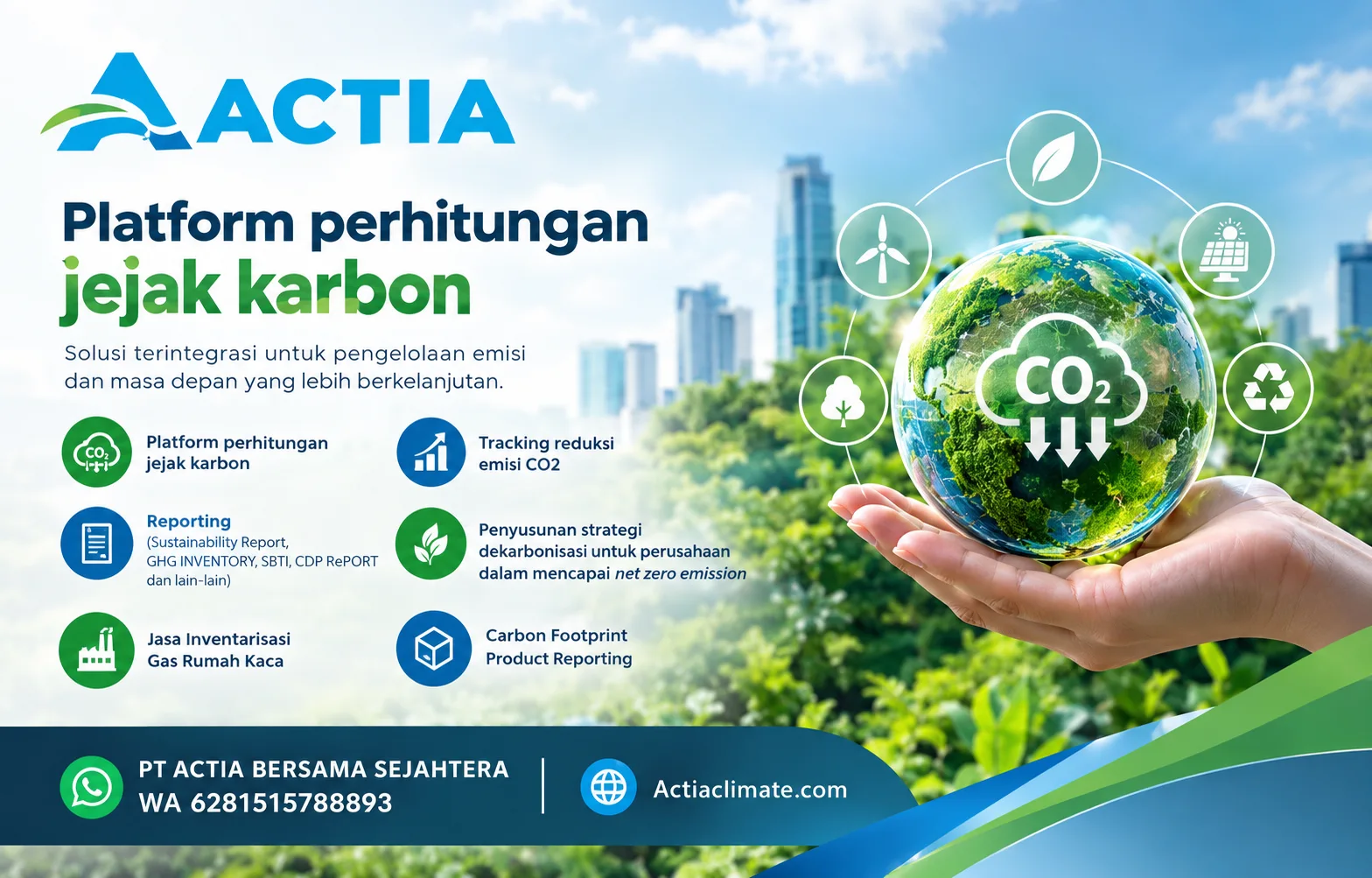
Why Choose Actia Climate for Carbon Footprint Consultancy Services?
Choosing an appropriate carbon management partner is an important decision for organizations seeking reliable environmental information and practical decarbonization support.
PT Actia Bersama Sejahtera combines greenhouse gas accounting expertise with digital solutions, training, and environmental management services.
Our Carbon Footprint Consultancy Services are designed to assist organizations with technical assessments, emissions documentation, and the development of practical environmental improvement plans.
Experienced Greenhouse Gas Accounting Professionals
Our team has experience supporting greenhouse gas inventory preparation and helping companies understand emissions accounting requirements across different business activities.
Technical Documentation and Verification Readiness
We support the preparation of emissions documentation using recognized accounting approaches and relevant international standards.
Where independent verification is necessary, the resulting information can be prepared for assessment by an appropriately qualified verification body.
Reliable Calculation Methods
Emissions calculations should be based on appropriate activity data, relevant emission factors, and transparent assumptions.
Actia emphasizes systematic data collection and methodological consistency to support defensible greenhouse gas accounting results.
Broad Scientific Reference Sources
Depending on the project requirements, relevant references may include IPCC guidance, Indonesian environmental guidelines, recognized emission factor databases, and peer-reviewed academic literature.
Responsive Technical Communication
Effective consultancy requires clear communication between specialists and internal company teams. We aim to support timely discussions, technical clarification, and coordinated project execution.
Practical Project Scheduling
Each inventory or consultancy project should have realistic milestones based on its reporting scope, data availability, and organizational complexity.
Our team works with clients to establish appropriate work plans and deliverables that reflect these requirements.
Explore our complete environmental and carbon management services to learn more about Actia’s capabilities.
Frequently Asked Questions About Carbon Footprint Consultancy Services
1. Why should companies use Carbon Footprint Consultancy Services?
Professional carbon footprint consultancy helps organizations apply appropriate greenhouse gas accounting methodologies, select suitable emission factors, and prepare reliable emissions information. Consultants can also help companies understand significant emissions sources and develop practical reduction strategies.
2. How long does a greenhouse gas inventory project take?
The duration depends on organizational size, operational complexity, reporting boundaries, and the availability of activity data. Some projects may take approximately one to three months, while more complex inventories can require additional time for data collection, calculations, and technical review.
3. Can small and medium-sized enterprises use carbon footprint consultancy?
Yes. Small and medium-sized enterprises can benefit from greenhouse gas assessments, particularly when responding to supply-chain requirements, preparing sustainability information, or identifying opportunities to improve resource efficiency. The assessment scope can be adjusted to the company’s activities and objectives.
4. What is the difference between a corporate carbon footprint and a product carbon footprint?
A corporate carbon footprint measures greenhouse gas emissions associated with an organization’s defined activities over a reporting period. A product carbon footprint measures greenhouse gas emissions associated with a particular product across selected or complete life-cycle stages, depending on the assessment boundary.
5. Does Actia provide air quality monitoring equipment?
Yes. Actia offers environmental monitoring equipment sales and rental support, including the Aeroqual S500 for applicable ambient air quality monitoring activities.
6. What information is required to begin a carbon footprint assessment?
Companies generally begin by defining their assessment objectives, reporting period, organizational boundaries, and major business activities. Relevant records may include electricity consumption, fuel use, transportation information, production activities, waste data, and additional information required for relevant Scope 3 emissions.
7. Can Carbon Footprint Consultancy Services support net-zero planning?
Yes. Reliable emissions inventories provide the baseline needed to identify reduction opportunities, develop measurable targets, and monitor progress toward long-term climate objectives. A credible net-zero strategy also requires realistic implementation plans and ongoing performance evaluation.
Start Your Carbon Footprint Consultancy Services with Actia Climate
PT Actia Bersama Sejahtera was established in April 2023 to provide environmental and greenhouse gas management solutions for companies in Indonesia.
Our services include corporate carbon footprint assessment, greenhouse gas inventory preparation, digital emissions calculation solutions, sustainability reporting assistance, decarbonization advisory, professional training, and environmental monitoring equipment support.
With offices in Jakarta and Surabaya, Actia supports companies seeking reliable approaches to environmental management and greenhouse gas accounting.
Whether your organization is beginning its first carbon footprint assessment or improving an existing emissions management program, our team can help identify the appropriate next steps.
Our Carbon Footprint Consultancy Services are designed to help businesses turn emissions information into practical environmental management decisions.
Contact PT Actia Bersama Sejahtera to discuss your greenhouse gas accounting, sustainability reporting, or decarbonization requirements.
WhatsApp: +62 815-1578-8893
Website: Actia Climate – Environmental and Carbon Management Solutions
Take the next step toward transparent emissions reporting, more effective carbon management, and a sustainable business future with Actia Climate.