
Carbon Footprint Consultancy helps businesses measure greenhouse gas emissions, improve environmental performance, and develop practical decarbonization strategies. As climate-related expectations continue to increase, companies need reliable emissions information to meet applicable reporting requirements, respond to investors, and make informed sustainability decisions.
Accurate carbon accounting begins with selecting a consultancy partner that understands greenhouse gas calculation methodologies, industry-specific emissions sources, and international reporting standards. Without suitable technical support, businesses may encounter difficulties collecting activity data, selecting emission factors, and preparing credible environmental disclosures.
PT Actia Bersama Sejahtera provides professional carbon management and environmental consulting solutions in Indonesia. By combining technical expertise with digital calculation tools, Actia supports companies in developing greenhouse gas inventories, evaluating emissions reduction opportunities, and preparing long-term decarbonization plans.
This guide explains how to select a reliable carbon consultant, the importance of internationally recognized methodologies, and the solutions available to help businesses achieve their sustainability objectives.
Table of Contents
- Why Businesses Need Carbon Footprint Consultancy
- 7 Proven Tips for Choosing a Carbon Consultant
- Carbon Calculation Software and Data Accuracy
- Life Cycle Assessment for Supply Chains
- SBTi Advisory and Decarbonization Targets
- Sustainability Reporting and ESG Disclosure
- Carbon Economy Training
- Ambient Air Quality Monitoring
- Actia Climate Consultancy Services
- Why Choose Actia Climate?
- Frequently Asked Questions
- Contact Actia Climate
Why Do Businesses Need Carbon Footprint Consultancy?
Professional Carbon Footprint Consultancy provides technical guidance for identifying greenhouse gas emissions sources, calculating emissions, and preparing reliable environmental information.
Businesses are increasingly expected to understand the environmental impacts of their operations. Customers, investors, lenders, and international business partners may request emissions information to evaluate sustainability performance and climate-related risks.
A competent consultancy helps organizations apply recognized methodologies such as the GHG Protocol and ISO 14064. These frameworks support consistent greenhouse gas accounting and transparent reporting.
Through a comprehensive greenhouse gas inventory assessment, companies can identify their direct and indirect emissions across business operations and relevant value-chain activities.
Corporate greenhouse gas inventories generally cover three categories:
- Scope 1: Direct emissions from sources owned or controlled by the company, such as fuel combustion in machinery and vehicles.
- Scope 2: Indirect emissions associated with purchased electricity, steam, heating, or cooling.
- Scope 3: Other indirect emissions across the company’s value chain, including purchased materials, transportation, business travel, and waste management.
Understanding these emissions categories allows management teams to identify significant carbon hotspots and establish appropriate reduction priorities.
Beyond regulatory readiness, carbon footprint assessments can reveal opportunities to improve energy efficiency, optimize resource consumption, and manage operational costs.
Reliable emissions information also creates a foundation for long-term climate strategies, including renewable energy adoption, process improvements, and corporate decarbonization planning.
7 Proven Tips for Choosing a Reliable Carbon Footprint Consultancy
Choosing the right Carbon Footprint Consultancy is an important decision because emissions assessment results may influence sustainability reporting, operational improvements, and investment planning.
A reliable consultant should demonstrate suitable technical expertise, transparent calculation methods, and an understanding of the business environment in which the client operates.
1. Evaluate Technical Experience and Industry Knowledge
Consultants should have relevant experience preparing greenhouse gas inventories and understanding the emissions characteristics of different industries.
For example, manufacturing facilities may require detailed assessments of production processes and energy consumption, while service companies may need stronger attention to purchased electricity, transportation, and value-chain emissions.
Reviewing relevant project experience helps businesses determine whether a consultancy can address their operational requirements.
2. Check Knowledge of International Carbon Accounting Standards
A professional carbon consultant should understand internationally recognized greenhouse gas accounting methodologies.
Important references include ISO 14064-1 for organizational greenhouse gas inventories, ISO 14067 for product carbon footprints, and the GHG Protocol for corporate greenhouse gas accounting.
ISO 14064-3:2019 provides requirements and guidance for validating and verifying greenhouse gas statements.
Understanding these standards supports consistency in emissions calculations and preparation for independent assessment.
3. Assess Emission Factor Selection and Data Quality
The reliability of carbon calculations depends on suitable activity data and relevant emission factors.
A competent consultant should explain how factors are selected, what assumptions are used, and whether the available information is appropriate for the organization.
Potential references include the Intergovernmental Panel on Climate Change (IPCC), Indonesian environmental guidance, recognized emissions databases, and peer-reviewed scientific literature.
4. Review Data Traceability and Documentation Procedures
Transparent documentation is essential for credible greenhouse gas reporting.
Consultants should establish a clear process for recording activity data, identifying information sources, documenting calculations, and maintaining supporting evidence.
Proper documentation makes it easier for businesses to review results and prepare information for potential third-party verification.
5. Evaluate Digital Carbon Accounting Capabilities
Digital calculation tools can improve the efficiency of data collection and reduce repetitive manual processing.
However, software alone does not guarantee accurate emissions results. Companies should evaluate the methodology, emission factors, data review procedures, and reporting capabilities used alongside the technology.
6. Confirm Understanding of Indonesian Regulations
Businesses operating in Indonesia should select consultants familiar with relevant national environmental regulations and carbon economic value mechanisms.
Reporting requirements vary by sector, organizational status, and business activity. A suitable consultant should help identify which obligations apply to the company and which reporting frameworks are appropriate.
7. Examine Communication, Project Planning, and Deliverables
Effective consultancy requires clear communication between technical specialists and company representatives.
Before beginning an assessment, businesses should understand the proposed scope, data requirements, reporting period, project milestones, review procedures, and expected deliverables.
A well-defined work plan helps both parties coordinate efficiently and reduce misunderstandings during the assessment process.
The Role of Carbon Footprint Calculation Software in Data Accuracy
Digital carbon accounting tools have become valuable resources for organizations managing emissions information across multiple departments and facilities.
A structured carbon footprint calculation platform can help businesses organize activity data, apply relevant emission factors, and develop consistent reporting procedures.
Modern software can also support periodic emissions monitoring and help management teams identify unusual trends or important emissions sources.
Within Carbon Footprint Consultancy, digital tools complement technical expertise by improving the organization and accessibility of emissions information.
Actia’s carbon footprint calculation platform is designed to support organizations in measuring and managing greenhouse gas emissions across relevant activities.
Key applications include organizing Scope 1, Scope 2, and Scope 3 information, identifying emissions hotspots, and supporting the development of targeted emissions reduction initiatives.
Digital records can also make it easier to maintain historical information and prepare supporting documentation for sustainability reporting.
However, calculations must still be reviewed to ensure that the underlying data, organizational boundaries, and emission factors are appropriate.
Why Life Cycle Assessment Matters for Supply Chains
Life Cycle Assessment (LCA) is a systematic approach for evaluating environmental impacts associated with a product or service across defined stages of its life cycle.
Depending on the scope, the assessment may consider raw material extraction, manufacturing, transportation, product use, and end-of-life treatment.
For manufacturers, life cycle information can reveal environmental hotspots that may not be apparent from direct operational emissions alone.
Companies can use LCA findings to investigate material efficiency, improve production processes, evaluate alternative raw materials, and identify opportunities to reduce environmental impacts.
A broader LCA can evaluate several environmental impact categories, while a product carbon footprint assessment focuses specifically on greenhouse gas emissions.
Recognized methodological references include ISO 14040 and ISO 14044 for Life Cycle Assessment and ISO 14067 for product carbon footprints.
Professional Carbon Footprint Consultancy can help businesses determine which assessment is appropriate for their objectives and prepare supporting technical information.
Product-level environmental data may also be requested by international buyers and supply-chain partners. The specific requirements depend on the destination market, product category, and applicable regulatory or certification framework.
Reliable assessments provide a stronger basis for product improvements and responsible environmental communications.
SBTi Advisory Services for Science-Based Decarbonization Targets
Many companies are establishing greenhouse gas reduction targets informed by climate science.
The Science Based Targets initiative (SBTi) provides standards, guidance, and a validation framework for companies seeking to set science-based emissions reduction targets.
These targets help organizations connect their decarbonization objectives with recognized climate pathways and relevant sectoral considerations.
Carbon footprint consultants can support companies in reviewing their existing greenhouse gas inventories, identifying information gaps, and evaluating possible target-setting approaches.
Advisory activities may include:
- Reviewing the completeness of greenhouse gas inventory data.
- Identifying the emissions categories relevant to target-setting requirements.
- Evaluating near-term and long-term greenhouse gas reduction pathways.
- Preparing relevant documentation for SBTi target submission processes.
- Developing a practical corporate decarbonization roadmap.
Achieving science-based targets requires ongoing implementation, investment, and emissions performance monitoring.
Any formal target validation is subject to the applicable SBTi assessment process. Engaging a consultancy does not automatically guarantee that a target will be validated.
Our Carbon Footprint Consultancy support helps businesses prepare the emissions information and internal planning necessary for credible climate action.
Preparing Sustainability Reports Using International Standards
A credible sustainability report communicates a company’s environmental, social, and governance performance to relevant stakeholders.
Greenhouse gas emissions information is an important part of environmental disclosure, but sustainability reporting also involves broader topics such as resource management, labor practices, governance, and organizational impacts.
Actia supports businesses in preparing and organizing emissions-related information for sustainability reporting.
Relevant frameworks and references may include the Global Reporting Initiative (GRI), CDP environmental disclosures, and applicable Indonesian Financial Services Authority requirements.
Consultancy activities can include:
- Organizing corporate greenhouse gas inventory results.
- Preparing emissions performance tables and supporting explanations.
- Documenting calculation methods and reporting assumptions.
- Presenting progress against environmental objectives.
- Identifying data gaps that require improvement before disclosure.
High-quality sustainability reporting should communicate both achievements and areas requiring further action.
Transparent reporting helps stakeholders understand the organization’s environmental performance without relying on unsupported sustainability claims.
Why Carbon Economy Training Is Important for Employees
The transition toward a low-carbon business model requires participation from employees, managers, and operational teams.
Organizations may encounter difficulties implementing carbon reduction strategies when internal teams do not understand greenhouse gas accounting or relevant environmental requirements.
Carbon economy training can help employees develop the knowledge necessary to support emissions measurement and reduction activities.
Training topics may include:
- Introduction to greenhouse gas emissions and carbon accounting.
- Understanding Scope 1, Scope 2, and Scope 3 emissions.
- Carbon pricing, emissions trading, and carbon market mechanisms.
- Practical emissions calculation techniques.
- Developing organizational greenhouse gas reduction measures.
- Understanding relevant Indonesian climate and carbon policies.
With appropriate training, internal teams can better understand their responsibilities and contribute to long-term environmental management.
Actia provides professional training programs covering carbon management, greenhouse gas inventories, ESG principles, and decarbonization strategies.
Learn more through our carbon economy and environmental training programs.
The Role of Ambient Air Quality Monitoring Equipment
Environmental management may require direct measurements of air quality conditions in addition to greenhouse gas accounting.
Ambient air monitoring helps organizations measure selected pollutant concentrations in their operating environment.
Businesses may use monitoring equipment to support environmental assessments, occupational health considerations, and relevant compliance activities.
Parameters can include carbon monoxide (CO), carbon dioxide (CO2), nitrogen dioxide (NO2), sulfur dioxide (SO2), and particulate matter, depending on the instrument and sensor configuration.
Actia provides sales and rental support for environmental measurement equipment, including the Aeroqual S500 portable air quality monitor.
The Aeroqual S500 uses interchangeable sensor heads designed for measuring selected gas pollutants and particulate matter.
Proper sensor selection, calibration, maintenance, and operating procedures are important for obtaining reliable measurements.
It is important to distinguish ambient air monitoring from corporate greenhouse gas inventories. Measuring pollutant concentrations at a location does not replace calculating total greenhouse gas emissions across business operations.
Carbon Footprint Consultancy Solutions from PT Actia Bersama Sejahtera
PT Actia Bersama Sejahtera provides carbon management solutions for organizations seeking to improve emissions accounting, reporting, and environmental performance.
Our professional carbon and environmental management services combine technical assistance, digital tools, and practical planning.
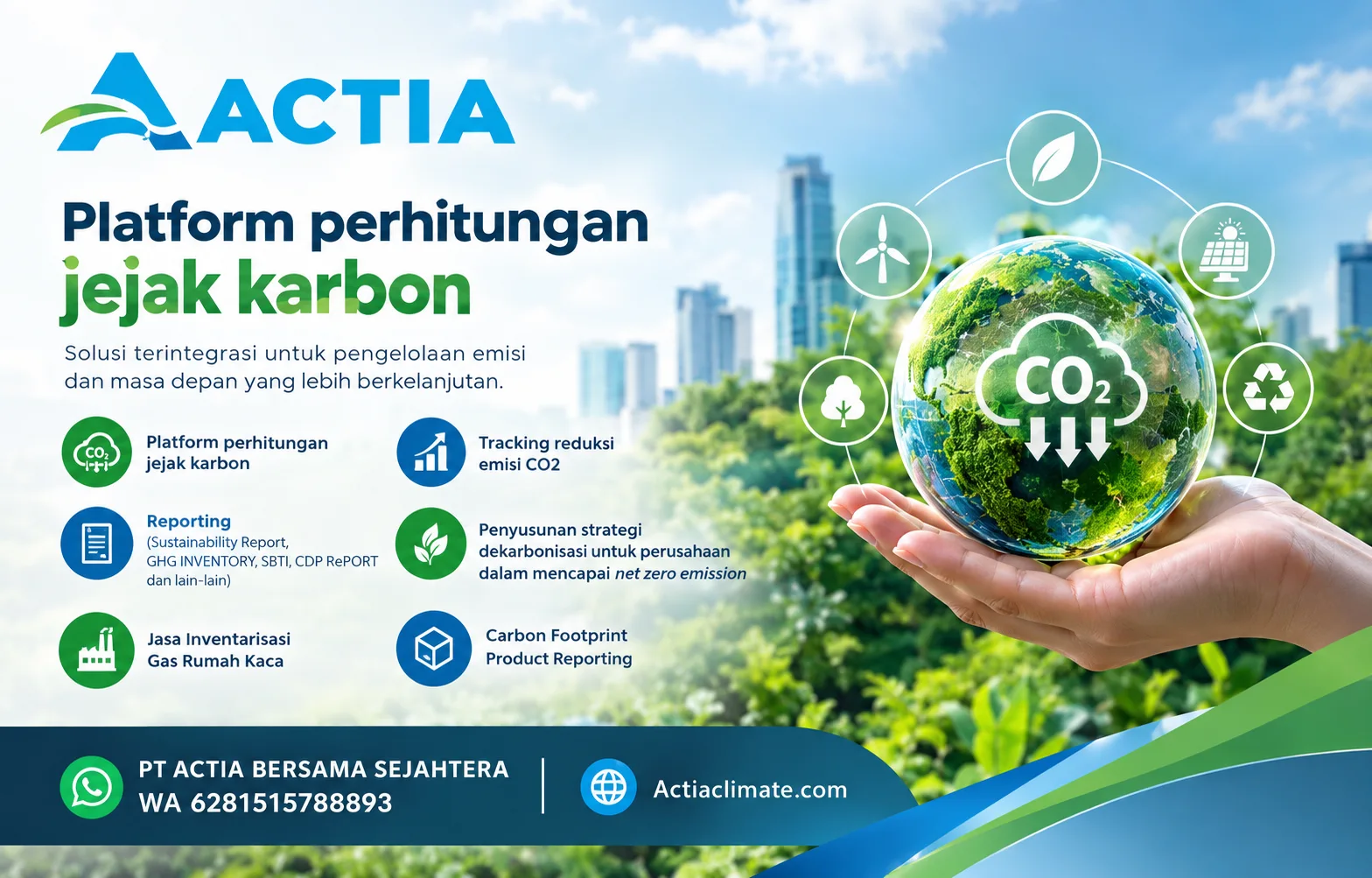
Carbon Footprint Calculation Platform
Actia offers a digital platform designed to help organizations manage greenhouse gas emissions information more effectively.
The platform supports structured emissions calculations and the identification of significant emissions sources.
- Access emission factor references covering relevant Scope 1, Scope 2, and Scope 3 activities.
- Organize activity data for greenhouse gas calculations.
- Identify important emissions hotspots.
- Support the analysis of opportunities for emissions reduction.
- Provide information that can contribute to sustainability reporting.
CO2 Emissions Reduction Tracking
Periodic tracking helps businesses evaluate changes in emissions performance and understand the effectiveness of implemented reduction measures.
Our approach emphasizes consistent reporting periods, traceable data, and the review of significant emissions trends.
- Track emissions performance over time.
- Assess progress against relevant reduction objectives.
- Identify operational activities contributing to significant emissions.
- Maintain historical emissions records.
- Support environmental reporting and management reviews.
Corporate Decarbonization Strategy Development
Decarbonization planning translates greenhouse gas inventory findings into practical improvement initiatives.
Actia assists organizations in identifying technically appropriate measures and developing implementation priorities.
- Provide guidance on short-term and long-term emissions reduction objectives.
- Develop practical corporate decarbonization roadmaps.
- Evaluate relevant low-carbon technologies.
- Support coordination with appropriate technology providers.
- Establish an emissions baseline for monitoring future progress.
Sustainability Reporting, GHG Inventory, SBTi, and CDP Assistance
Reliable reporting requires clear methodologies, consistent data, and transparent documentation.
Actia helps organizations organize emissions information for appropriate sustainability reporting and climate-related disclosure processes.
- Prepare corporate greenhouse gas inventory documentation.
- Support sustainability reporting using relevant international frameworks.
- Assist with the preparation of CDP disclosure information.
- Provide advisory support for applicable SBTi target-setting processes.
- Organize product carbon footprint information for stakeholders.
Greenhouse Gas Inventory Consulting
Actia provides assistance with greenhouse gas inventory preparation, including identifying emissions sources, selecting appropriate calculation methods, and collecting relevant operational information.
Technical support may involve field assessments, activity data reviews, and preparation of documentation suitable for independent examination.
- Identify relevant greenhouse gas emissions sources.
- Review activity data and organizational boundaries.
- Recommend appropriate calculation methods.
- Develop transparent emissions calculation documentation.
- Organize inventory information for relevant reporting or registration requirements.
ISO 14064-3:2019 provides guidance for verification and validation of greenhouse gas statements. Any formal independent verification must be undertaken through the appropriate qualified verification arrangements.
Environmental Monitoring Equipment Sales and Rental
Actia also supports environmental monitoring activities through equipment sales, rental, and technical assistance.
- Provide Aeroqual S500 equipment options for ambient air quality monitoring.
- Offer instrument rental solutions for periodic measurement requirements.
- Provide guidance on suitable sensor configurations.
- Support appropriate equipment operation and calibration arrangements.
- Assist with environmental monitoring equipment requirements.
Why Choose Actia Climate for Carbon Footprint Consultancy?
Choosing a suitable environmental consulting partner requires confidence in technical competence, calculation methods, and the quality of the information delivered.
PT Actia Bersama Sejahtera combines greenhouse gas accounting experience with digital solutions and environmental management support.
Our Carbon Footprint Consultancy approach is designed to help organizations understand emissions results and make informed decisions about sustainability improvements.
Technical Expertise
Our team has experience supporting greenhouse gas inventories and helping organizations apply appropriate emissions calculation methods.
Recognized Accounting References
We use relevant greenhouse gas accounting frameworks and technical references to support consistent and transparent inventory preparation.
Reliable Data Management
Accurate emissions assessment requires suitable activity data, relevant emission factors, and clear calculation assumptions.
Actia emphasizes organized data collection and appropriate technical review throughout the consulting process.
Access to Scientific Information
Relevant sources may include IPCC methodologies, Indonesian environmental guidance, recognized emissions databases, and academic literature.
Responsive Communication
We aim to maintain clear communication with client representatives throughout assessment and reporting activities.
Practical Project Management
Work plans and deliverables can be developed according to organizational requirements, available information, and assessment complexity.
These capabilities help companies approach environmental management with clearer information and more structured decision-making.
Frequently Asked Questions About Carbon Footprint Consultancy
1. What standards are used in carbon footprint calculations?
Professional consultants commonly use the GHG Protocol, ISO 14064, and ISO 14067, depending on the assessment objectives. These standards and methodologies provide guidance for developing consistent greenhouse gas inventories and product carbon footprint assessments.
2. How long does a greenhouse gas inventory project usually take?
The project duration depends on business size, operational complexity, reporting boundaries, and data availability. Some medium-sized corporate inventories may take approximately one to three months, while more complex assessments can require additional time.
3. Do small businesses need carbon footprint consultancy?
Small businesses can benefit from emissions assessments when responding to customer requests, improving resource efficiency, or preparing environmental information. The appropriate scope should reflect the company’s activities, objectives, and available resources.
4. What is the difference between Scope 1, Scope 2, and Scope 3?
Scope 1 includes direct greenhouse gas emissions from sources owned or controlled by the company. Scope 2 covers indirect emissions associated with purchased energy. Scope 3 includes other indirect emissions within the organization’s value chain, such as purchased materials and business travel.
5. Why do companies use equipment such as the Aeroqual S500?
The Aeroqual S500 helps environmental professionals measure selected ambient air pollutants using compatible sensors. These measurements can support environmental monitoring activities, but they do not replace comprehensive corporate greenhouse gas accounting.
6. How can carbon footprint consultancy support sustainability reporting?
Consultants can help businesses collect emissions data, apply recognized methodologies, organize supporting documentation, and prepare environmental information for relevant sustainability disclosures.
7. What should companies prepare before hiring a carbon consultant?
Companies should identify their assessment objectives, reporting period, business locations, major operational activities, and available energy or emissions-related records. These details help consultants define an appropriate work scope and data collection plan.
Professional Carbon Footprint Consultancy in Indonesia
PT Actia Bersama Sejahtera is an environmental and carbon management services provider established in April 2023.
With offices in Jakarta and Surabaya, Actia supports businesses seeking practical solutions for greenhouse gas inventory preparation, corporate carbon footprint assessment, sustainability reporting, decarbonization planning, environmental training, and monitoring equipment requirements.
Our consulting approach combines technical guidance with structured data management to help organizations understand their environmental performance and identify relevant improvement opportunities.
Whether your company is preparing its first greenhouse gas inventory or developing a comprehensive decarbonization strategy, our team can help determine the appropriate starting point.
Contact Actia Climate for Carbon Footprint Consultancy. Discuss your organization’s carbon accounting and sustainability requirements with our team.
WhatsApp: +62 815-1578-8893
Website: Actia Climate
Build a more reliable foundation for carbon management, environmental reporting, and long-term business sustainability with PT Actia Bersama Sejahtera.