
Carbon Footprint Consultancy Services help companies measure greenhouse gas emissions, improve environmental transparency, and develop effective decarbonization strategies. As climate-related risks and sustainability expectations increase, businesses need reliable emissions data to strengthen environmental reporting and support long-term competitiveness.
Professional carbon consultancy provides more than technical emissions calculations. It helps organizations identify environmental risks, evaluate operational efficiency, understand applicable regulations, and communicate sustainability performance to investors, customers, and other stakeholders.
PT Actia Bersama Sejahtera provides Carbon Footprint Consultancy Services in Indonesia, combining greenhouse gas accounting expertise, digital carbon management tools, sustainability reporting support, and practical decarbonization planning.
This article explores seven important benefits of professional carbon footprint consultancy, from improving the credibility of greenhouse gas inventories to strengthening business resilience in the transition toward a low-carbon economy.
Table of Contents
- 1. Building Credibility Through Accurate GHG Inventories
- 2. Supporting Carbon Regulatory Compliance
- 3. Strengthening ESG Performance and Investor Confidence
- 4. Improving Operational Efficiency
- 5. Increasing Product Competitiveness
- 6. Preparing for Net-Zero Targets
- 7. Managing Environmental and Reputational Risks
- Carbon Management Solutions by Actia Climate
- Why Choose Actia Climate?
- Frequently Asked Questions
- Contact Actia Climate
1. Building Credibility Through Accurate Greenhouse Gas Inventories
The first step toward effective corporate carbon management is understanding the greenhouse gas emissions associated with business operations.
A comprehensive greenhouse gas inventory provides a structured record of emissions sources, calculation methodologies, activity data, and relevant emission factors. This information helps companies establish a reliable emissions baseline for environmental reporting and future improvement initiatives.
Professional Carbon Footprint Consultancy Services help organizations prepare inventories using recognized methodologies such as the GHG Protocol and ISO 14064-1.
These methodologies support consistent accounting procedures and improve the transparency of reported emissions information.
Understanding Corporate Emissions Sources
A corporate greenhouse gas inventory generally addresses three emissions categories:
- Scope 1: Direct greenhouse gas emissions from sources owned or controlled by the organization, including fuel combustion in company vehicles and equipment.
- Scope 2: Indirect greenhouse gas emissions associated with purchased electricity, heating, steam, and cooling.
- Scope 3: Other indirect emissions across the value chain, such as purchased materials, transportation, business travel, waste, and relevant product-related activities.
Scope 3 emissions can be particularly challenging because companies may depend on information from suppliers, transportation providers, and other external parties.
Carbon consultants assist businesses in determining suitable inventory boundaries, evaluating data quality, and documenting calculation assumptions.
Accurate emissions information enables management teams to make decisions based on documented evidence rather than unsupported estimates.
It also provides a stronger foundation for independent verification, sustainability reporting, and stakeholder communication.
Businesses can learn more about recognized corporate accounting approaches through the GHG Protocol standards.
2. Supporting National and International Carbon Regulatory Compliance
Climate-related regulations and reporting requirements are becoming increasingly relevant to businesses operating in Indonesia and international markets.
Different industries may face specific requirements concerning greenhouse gas emissions, environmental reporting, carbon pricing, and sustainability disclosures.
Carbon Footprint Consultancy Services help companies understand the technical information required for relevant reporting and compliance activities.
Carbon Regulations in Indonesia
Indonesia has developed regulatory frameworks addressing carbon economic value mechanisms and greenhouse gas emissions management.
Reporting and compliance requirements depend on the applicable regulations, industry classification, business activities, and organizational circumstances.
Professional consultants can help organizations identify relevant reporting needs and develop appropriate emissions documentation.
This can reduce uncertainty when preparing environmental information for regulators, management teams, or business partners.
Preparing for International Carbon Requirements
International trade requirements are also creating new considerations for companies supplying carbon-intensive products to overseas markets.
One important example is the European Union’s Carbon Border Adjustment Mechanism (CBAM), which entered its definitive regime on January 1, 2026.
CBAM covers selected goods in sectors including cement, iron and steel, aluminium, fertilisers, electricity, and hydrogen.
For affected supply chains, reliable embedded-emissions information can help producers respond to relevant information requests and compliance arrangements.
Companies can review the official European Commission CBAM guidance for details of the mechanism.
Working with experienced consultants helps businesses understand how carbon accounting requirements may affect their operations, supply chains, and international business relationships.
3. Strengthening ESG Performance and Investor Confidence
Environmental, Social, and Governance (ESG) considerations are increasingly included in corporate investment assessments and business risk evaluations.
Investors and financial institutions may review a company’s environmental performance, climate-related risks, and sustainability management practices alongside traditional financial information.
Reliable greenhouse gas data can strengthen the environmental information available for these assessments.
Carbon Footprint Consultancy Services support the preparation of emissions inventories and performance indicators that can contribute to corporate ESG disclosures.
Connecting Carbon Management with ESG Reporting
Carbon management is an important component of environmental performance assessment.
Companies can use their greenhouse gas inventories to identify significant emissions sources, establish reduction priorities, and communicate progress against defined objectives.
Professional consulting also supports the organization of environmental information for relevant sustainability reporting frameworks.
These may include the Global Reporting Initiative (GRI), CDP environmental disclosures, and applicable Indonesian sustainability reporting requirements.
Supporting Green Financing Readiness
Some financial institutions consider environmental performance and climate-related risk management when evaluating financing opportunities.
A well-documented emissions inventory and credible decarbonization plan can provide useful supporting information for financing discussions.
However, carbon reporting alone does not guarantee access to green financing or favorable borrowing conditions.
The potential financial benefits depend on the company’s circumstances, lender requirements, and the quality of the overall business and sustainability strategy.
4. Improving Operational Efficiency Through Carbon Footprint Calculations
One of the practical benefits of corporate carbon footprint assessments is the identification of inefficient resource consumption.
Greenhouse gas emissions are often associated with energy use, fuel consumption, transportation, manufacturing processes, and material procurement.
By understanding these activities, businesses can identify opportunities to improve operational performance.
Carbon Footprint Consultancy Services help management teams interpret emissions results and prioritize areas where improvements may be technically and financially feasible.
Identifying Carbon Hotspots
A carbon hotspot is an activity, process, facility, or value-chain stage responsible for a significant share of an organization’s greenhouse gas emissions.
Examples may include:
- High electricity consumption in industrial equipment.
- Inefficient fuel use in transportation and logistics.
- Energy-intensive manufacturing processes.
- High-carbon raw materials and purchased products.
- Operational practices that create unnecessary energy demand.
Identifying these hotspots enables companies to focus their improvement efforts on activities with meaningful reduction potential.
Using Carbon Calculation Software
Digital carbon accounting tools can help businesses organize activity data and monitor emissions across reporting periods.
The Actia Carbon Footprint Calculation Platform is designed to support the preparation and management of corporate emissions information.
Using appropriate calculation methods and emission factors, organizations can evaluate emissions patterns and identify potential opportunities for improvement.
Digital tools can reduce repetitive administrative work and improve data consistency. However, their results still depend on the quality of the underlying activity data and calculation assumptions.
Potential operational improvements may include equipment upgrades, energy-efficiency measures, process optimization, and more efficient logistics planning.
Each initiative should be evaluated for expected emissions reductions, investment requirements, and operational feasibility.
5. Increasing Product Competitiveness Through Carbon Footprint Reporting
Environmental information is becoming increasingly important in product development, procurement, and international supply-chain relationships.
Some customers and business partners request information about the greenhouse gas emissions associated with the products they purchase.
Product carbon footprint assessments can help manufacturers respond to these requests using documented calculation methods.
Within Carbon Footprint Consultancy Services, product-level assessments may involve carbon footprint quantification or a broader Life Cycle Assessment (LCA).
Understanding Product Life Cycle Assessment
Life Cycle Assessment evaluates environmental impacts associated with a product or service throughout defined stages of its life cycle.
These stages may include:
- Raw material extraction and procurement.
- Manufacturing and processing.
- Packaging and distribution.
- Product use and maintenance.
- End-of-life treatment, recycling, or disposal.
A product carbon footprint focuses specifically on greenhouse gas emissions, while a broader LCA may examine additional environmental impact categories.
Recognized references include ISO 14040 and ISO 14044 for Life Cycle Assessment and ISO 14067 for product carbon footprints.
Supporting Credible Environmental Product Claims
Product-level emissions information can help businesses identify improvement opportunities and communicate environmental performance more transparently.
Companies may use appropriately documented assessments to support relevant product disclosures or certification applications.
However, measuring a product’s carbon footprint does not automatically establish that the product is environmentally friendly or qualify it for a particular ecolabel.
Environmental claims should reflect the assessment’s actual findings, limitations, and applicable verification requirements.
With reliable information, manufacturers can evaluate opportunities to reduce material consumption, improve energy efficiency, and strengthen their approach to sustainable product development.
6. Preparing for Net-Zero Targets Through SBTi Advisory Services
Many organizations have established long-term commitments to reduce their greenhouse gas emissions.
Achieving meaningful reductions requires a credible emissions baseline, appropriate targets, practical implementation measures, and consistent performance monitoring.
Carbon Footprint Consultancy Services help companies establish a structured approach to these activities.
Understanding Science-Based Targets
The Science Based Targets initiative (SBTi) provides standards and guidance for companies seeking to establish greenhouse gas reduction targets informed by climate science.
Science-based target setting requires companies to evaluate their emissions profiles and identify suitable pathways for reducing emissions over time.
Consultants may assist with:
- Reviewing the completeness of corporate greenhouse gas inventories.
- Identifying relevant emissions categories and reporting boundaries.
- Evaluating near-term and long-term reduction targets.
- Preparing information for applicable SBTi submission processes.
- Developing implementation plans and monitoring arrangements.
Formal SBTi target validation is subject to the applicable assessment procedures and is not automatically guaranteed by engaging a consultancy provider.
Developing a Practical Decarbonization Roadmap
A corporate decarbonization roadmap connects emissions reduction objectives with practical implementation activities.
Depending on the organization’s circumstances, the roadmap may include energy efficiency, renewable energy, industrial process improvements, lower-emission transportation, and supplier engagement.
Successful implementation requires coordination between management, operational personnel, procurement teams, and other relevant departments.
Regular emissions tracking allows companies to review progress, evaluate the effectiveness of implemented measures, and make adjustments when necessary.
7. Managing Environmental Reputation and Stakeholder Risks
Environmental credibility depends on the consistency between a company’s public commitments and its actual performance.
Businesses that publish unsupported environmental claims may face reputational risks, stakeholder criticism, and concerns about greenwashing.
Professional Carbon Footprint Consultancy Services can support more transparent environmental communications by helping organizations produce reliable emissions information.
Reducing the Risk of Unsupported Claims
Credible environmental reporting should explain the company’s accounting methods, reporting boundaries, data limitations, reduction measures, and progress toward its objectives.
Transparent communication should also acknowledge challenges and areas where further improvements are required.
This approach provides stakeholders with a more balanced understanding of the organization’s environmental performance.
Building Internal Carbon Management Awareness
Effective environmental management also requires employees to understand their responsibilities.
Carbon economy training can help personnel develop practical knowledge of greenhouse gas accounting, emissions reduction, and climate-related business considerations.
Training activities may address carbon pricing, carbon markets, corporate emissions inventories, and operational efficiency.
Organizations can explore relevant learning opportunities through Actia Climate’s carbon management and ESG training programs.
Building internal capabilities helps companies maintain more consistent environmental management practices and support long-term improvement initiatives.
Carbon Footprint Consultancy Services and Solutions by Actia Climate
PT Actia Bersama Sejahtera provides carbon management solutions designed to support organizations at different stages of their sustainability journey.
Our Carbon Footprint Consultancy Services combine greenhouse gas accounting, digital calculation tools, reporting assistance, decarbonization advisory, and environmental management support.
1. Actia Carbon Footprint Calculation Platform
The Actia platform provides a digital approach to organizing greenhouse gas emissions data and supporting carbon footprint calculations.
The platform is designed to help organizations understand their emissions profiles and identify opportunities for improvement.
- Access emission factor references for relevant individual and industrial activities.
- Calculate emissions associated with Scope 1, Scope 2, and applicable Scope 3 activities.
- Identify significant emissions sources and carbon hotspots.
- Support the organization of information for sustainability disclosures.
- Assist with the planning of data-informed emissions reduction initiatives.
2. CO2 Emissions Reduction Tracking
Consistent emissions tracking allows organizations to compare performance across reporting periods.
Actia supports the use of historical emissions data to evaluate changes in operational performance and the results of reduction activities.
- Monitor emissions trends across relevant reporting periods.
- Identify significant emissions sources in operational activities.
- Evaluate progress following the implementation of reduction measures.
- Analyze operational practices that contribute to emissions.
- Maintain historical records for environmental reporting and review.
3. Sustainability Reporting and International Disclosure
Actia assists businesses in organizing greenhouse gas information for sustainability reporting and related disclosures.
Services may include support for preparing emissions inventory information, ESG reporting materials, and applicable climate-related disclosures.
- Prepare greenhouse gas inventory documentation using recognized methodologies.
- Support sustainability reporting with reference to relevant GRI standards.
- Organize emissions information for applicable Indonesian OJK requirements.
- Assist with CDP disclosure preparation and SBTi target-setting documentation.
- Present emissions data in clear, accessible reports and supporting materials.
4. Corporate Decarbonization Strategy Development
After establishing an emissions baseline, companies can develop practical strategies to reduce greenhouse gas emissions.
Actia supports organizations in evaluating suitable reduction opportunities and developing implementation priorities.
- Establish an appropriate emissions baseline year.
- Develop realistic and measurable decarbonization roadmaps.
- Assess energy efficiency and renewable energy opportunities.
- Identify relevant low-carbon technology options and providers.
- Support the monitoring of progress toward long-term reduction objectives.
5. Greenhouse Gas Inventory and Product Carbon Footprint Consulting
Actia provides technical support for preparing corporate greenhouse gas inventories and assessing product-level emissions.
Our services help organizations determine appropriate assessment boundaries, collect relevant data, and document calculation methods.
- Support the preparation of organizational greenhouse gas inventories.
- Assist with Scope 1, Scope 2, and relevant Scope 3 emissions calculations.
- Evaluate product carbon footprints using applicable methodologies.
- Identify opportunities to reduce carbon intensity in production processes.
- Organize technical documentation for relevant reporting and independent review requirements.
6. Environmental Monitoring Equipment Sales and Rental
Alongside carbon management consultancy, Actia provides environmental monitoring equipment support for industrial and environmental applications.
Available solutions include sales and rental services for ambient air quality monitoring instruments such as the Aeroqual S500.
- Portable ambient air quality monitoring equipment options.
- Rental support for specific monitoring requirements.
- Appropriate sensor selection for relevant air quality parameters.
- Technical guidance related to equipment operation and calibration.
- Support for periodic environmental monitoring activities.
Ambient air quality measurements and corporate greenhouse gas inventories serve different purposes. Air pollutant concentration measurements should not be treated as a substitute for organizational greenhouse gas accounting.
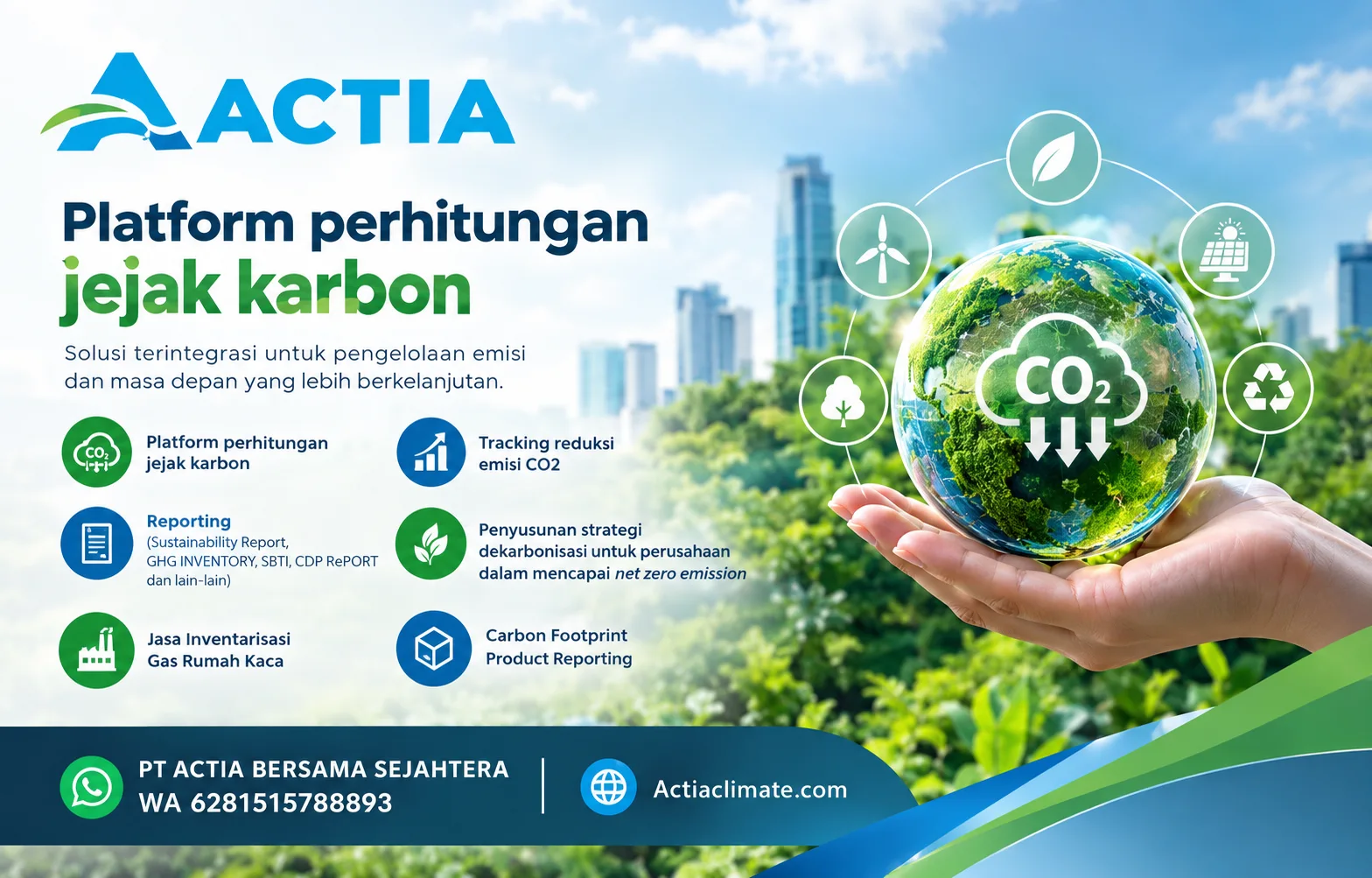
Why Choose PT Actia Bersama Sejahtera for Carbon Footprint Consultancy Services?
Selecting an appropriate carbon management partner requires evaluating technical expertise, calculation methodologies, communication quality, and the ability to deliver useful environmental information.
PT Actia Bersama Sejahtera combines greenhouse gas accounting expertise with digital carbon management solutions and environmental consulting support.
Experience in Greenhouse Gas Inventory Preparation
Our team has experience supporting businesses with greenhouse gas inventory processes, calculation methodologies, and environmental reporting requirements.
Internationally Recognized Accounting Methodologies
Our approach draws on relevant greenhouse gas accounting frameworks, including the GHG Protocol and the ISO 14064 family of standards.
ISO 14064-3:2019 provides specifications for the verification and validation of greenhouse gas statements. Formal independent verification, where required, must be conducted through an appropriately qualified verification body.
Technical Data Quality and Documentation
Reliable emissions assessments require appropriate activity information, relevant emission factors, and transparent calculation assumptions.
We emphasize structured information collection and documentation to support consistent greenhouse gas accounting.
Access to Scientific and Technical References
Depending on project requirements, emissions calculations may draw on international guidance from the IPCC, Indonesian environmental references, recognized databases, and relevant scientific literature.
Responsive Communication and Project Coordination
Effective consulting requires clear communication between technical specialists and client representatives.
Our approach prioritizes structured project coordination, practical technical explanations, and realistic work planning.
Integrated Environmental Management Support
Beyond greenhouse gas calculations, Actia supports environmental reporting, professional training, decarbonization planning, and relevant monitoring equipment requirements.
Explore our complete carbon and environmental management services for more information.
Frequently Asked Questions About Carbon Footprint Consultancy Services
1. What is the difference between a greenhouse gas inventory and a carbon footprint?
A greenhouse gas inventory typically refers to a structured accounting of emissions within defined organizational or geographical boundaries. The term carbon footprint is used more broadly to describe greenhouse gas emissions associated with an organization, product, service, activity, or individual.
2. How long does it take to prepare a corporate carbon footprint report?
The duration depends on organizational size, operational complexity, reporting boundaries, and data availability. Some projects may take approximately one to three months, while larger or more complex assessments may require additional time.
3. Can small and medium-sized businesses benefit from Carbon Footprint Consultancy Services?
Yes. Small and medium-sized businesses may benefit from emissions assessments when responding to supply-chain requests, improving resource efficiency, preparing sustainability information, or evaluating environmental improvement opportunities.
4. Which standards are used for greenhouse gas verification?
ISO 14064-1 provides requirements for organizational greenhouse gas accounting, while ISO 14067 addresses product carbon footprint quantification. ISO 14064-3:2019 provides requirements and guidance for the verification and validation of greenhouse gas statements.
5. How can a company begin its decarbonization journey?
A practical starting point is to establish a greenhouse gas inventory and identify significant emissions sources. Companies can then evaluate reduction opportunities, establish appropriate targets, and develop an implementation roadmap supported by regular monitoring.
6. What information should businesses prepare before contacting a carbon consultant?
Companies should identify their assessment objectives, reporting period, operating locations, major business activities, and available emissions-related records. Information such as electricity consumption, fuel use, transportation activities, and production data can help define the project scope.
7. Can carbon footprint consultancy improve ESG performance?
Professional consultancy can help companies produce reliable environmental information, identify emissions reduction opportunities, and organize data for sustainability disclosures. Improvements in overall ESG performance depend on how effectively the organization implements and manages its environmental, social, and governance activities.
Start Your Carbon Footprint Consultancy Services with Actia Climate
PT Actia Bersama Sejahtera, established in April 2023, provides environmental and carbon management solutions for companies in Indonesia.
With offices in Jakarta and Surabaya, Actia supports businesses seeking reliable greenhouse gas accounting, sustainability reporting assistance, product carbon footprint assessments, and corporate decarbonization planning.
Our Carbon Footprint Consultancy Services help organizations understand their emissions profiles, identify improvement opportunities, and develop structured environmental management strategies.
Whether your company is preparing its first greenhouse gas inventory or improving an existing sustainability program, Actia can help evaluate the appropriate assessment scope and next steps.
Contact PT Actia Bersama Sejahtera to discuss your carbon accounting, emissions reporting, or decarbonization requirements.
WhatsApp: +62 815-1578-8893
Website: Actia Climate – Carbon and Environmental Management Solutions
Build a stronger foundation for transparent environmental reporting, effective emissions management, and long-term business sustainability with Actia Climate.