
Carbon Footprint Consulting Services help companies measure greenhouse gas emissions, improve carbon accounting accuracy, and develop practical strategies for reducing their environmental impact. For businesses deciding between in-house carbon accounting and professional consulting, understanding the differences in cost, technical expertise, data quality, and reporting requirements is essential.
Many companies in Indonesia are moving beyond basic electricity monitoring toward comprehensive greenhouse gas management. Growing sustainability expectations, supply-chain requirements, and environmental regulations have increased the importance of accurate corporate emissions reporting.
However, businesses often face an important decision: should they calculate their carbon footprints using internal resources, or should they work with an experienced carbon footprint consultant?
This article compares both approaches and explains how Carbon Footprint Consulting Services can support greenhouse gas inventories, emissions tracking, sustainability reporting, product life cycle assessments, and corporate decarbonization strategies.
Table of Contents
- Why Corporate Carbon Footprint Management Matters
- In-House Carbon Accounting: Benefits and Challenges
- Why Companies Choose Professional Carbon Consultants
- 7 Factors: In-House vs Professional Consulting
- GHG Inventory Methodology and Standards
- Actia Carbon Footprint Calculation Platform
- CO2 Emissions Reduction Tracking
- Sustainability Reporting and ESG Disclosure
- Corporate Decarbonization and Net-Zero Roadmap
- Professional GHG Inventory Consulting
- Product Carbon Footprint Reporting and LCA
- SBTi Advisory and Science-Based Targets
- Aeroqual S500 Air Quality Monitoring
- Why Carbon Data Accuracy Matters
- How to Choose the Right Carbon Consultant
- Frequently Asked Questions
- Contact Actia Climate
Why Corporate Carbon Footprint Management Matters
In today’s transition toward a low-carbon economy, greenhouse gas management has become an important consideration for businesses across different industries.
Indonesia’s climate commitments under its Nationally Determined Contribution (NDC), together with relevant environmental regulations and market expectations, are encouraging organizations to better understand their emissions.
Companies that cannot provide reliable carbon information may encounter difficulties responding to sustainability-related requests from customers, investors, financial institutions, and international business partners.
Meanwhile, organizations with structured emissions management processes can identify opportunities to improve resource efficiency, strengthen environmental transparency, and support long-term business planning.
Effective carbon management starts with understanding direct and indirect greenhouse gas emissions across relevant business activities.
These activities may include fuel consumption, electricity use, manufacturing processes, transportation, purchased materials, waste generation, and other value-chain operations.
Carbon Footprint Consulting Services provide technical assistance to help companies quantify these emissions using appropriate methodologies and supporting evidence.
A credible greenhouse gas inventory also provides a foundation for future emissions reduction programs, ESG reporting, and climate-related performance monitoring.
In-House Carbon Accounting: Benefits and Challenges
Many businesses initially calculate their carbon footprints using internal employees, spreadsheets, or basic emissions calculation tools.
This approach can be suitable for organizations with relatively straightforward operations, limited emissions sources, and employees who understand greenhouse gas accounting principles.
Advantages of In-House Carbon Accounting
One of the main advantages of conducting carbon calculations internally is direct control over the collection and management of company information.
Internal teams are familiar with operating processes, energy consumption records, procurement activities, and other business information required for emissions calculations.
Potential benefits include:
- Greater control over internal activity data and supporting documents.
- Flexibility to conduct calculations according to operational schedules.
- Opportunities to develop internal knowledge of greenhouse gas accounting.
- Potentially lower external consulting expenditure for simple assessments.
- Direct collaboration between sustainability, operations, and finance teams.
For organizations with qualified personnel and established procedures, internal greenhouse gas accounting can be an effective long-term approach.
Challenges of Conducting Carbon Assessments Internally
Despite these advantages, in-house carbon accounting can present significant technical challenges.
Employees may have limited experience selecting appropriate emission factors, determining organizational boundaries, or interpreting international greenhouse gas accounting standards.
Complexities often increase when companies calculate indirect emissions from suppliers, transportation, purchased products, and other Scope 3 activities.
Common challenges include:
- Limited access to industry-specific greenhouse gas accounting expertise.
- Uncertainty about selecting appropriate emission factors and calculation methods.
- Incorrect classification of Scope 1, Scope 2, and Scope 3 emissions.
- Inconsistent data collection across departments or operating locations.
- Difficulty documenting assumptions and preparing evidence for independent review.
- Additional employee time required for complex emissions calculations and data reconciliation.
Without suitable procedures, these issues can reduce the reliability of the final greenhouse gas inventory.
However, an internally prepared inventory is not automatically invalid. Its suitability depends on the accounting methodology, data quality, documentation, and applicable reporting requirements.
Why Companies Choose Carbon Footprint Consulting Services
Professional Carbon Footprint Consulting Services provide businesses with technical guidance throughout the emissions assessment process.
Experienced consultants help organizations identify relevant emissions sources, establish appropriate reporting boundaries, select calculation methodologies, and prepare supporting documentation.
Recognized references include the GHG Protocol Corporate Standard and the ISO 14064 family of standards.
Professional support can be especially useful when organizations have complex operating structures, multiple facilities, significant Scope 3 emissions, or specific disclosure requirements.
Technical Expertise and Emission Factor Selection
Carbon consultants can help businesses select appropriate emission factors based on activity type, geographical location, reporting requirements, and available information.
Relevant references may include IPCC methodologies, Indonesian environmental guidance, recognized emissions databases, and industry-specific scientific literature.
Consultants can also evaluate data limitations and explain how calculation assumptions affect reported greenhouse gas emissions.
Connecting Carbon Data with Business Strategy
Professional consulting extends beyond calculating total emissions.
Consultants can assist management teams in identifying significant emissions sources, evaluating improvement opportunities, and developing realistic emissions reduction strategies.
This approach helps companies connect greenhouse gas accounting with operational efficiency, sustainability reporting, and corporate environmental objectives.
Although professional services require an additional investment, they may provide value through technical expertise, better documentation, and more efficient management of complex assessment activities.
7 Factors to Compare In-House Accounting and Carbon Footprint Consulting Services
Before deciding how to conduct a carbon footprint assessment, businesses should compare the capabilities and limitations of both approaches.
The following seven factors can help organizations determine whether internal accounting, professional consulting, or a combination of both is most appropriate.
| Evaluation Factor | In-House Carbon Accounting | Professional Consulting |
|---|---|---|
| 1. Initial Cost | May reduce external consulting expenditure but requires employee time and suitable tools. | Requires consulting expenditure, with costs depending on project complexity and scope. |
| 2. Technical Expertise | Depends on the knowledge and experience of internal employees. | Provides access to specialists familiar with greenhouse gas accounting methodologies. |
| 3. Data Quality | Depends on internal data controls, documentation, and review procedures. | Can provide methodological guidance and additional technical review. |
| 4. Scope 3 Complexity | May require extensive supplier coordination and specialized calculations. | Can assist with value-chain emissions assessment and appropriate data collection methods. |
| 5. Reporting Readiness | Requires employees to understand applicable standards and disclosure requirements. | Can support preparation of structured emissions reports and supporting documentation. |
| 6. Project Resources | Relies primarily on internal personnel and operational availability. | Provides additional project resources and specialized technical support. |
| 7. Long-Term Capability | Builds internal knowledge through continuous practice. | Can strengthen internal capability through guidance, training, and knowledge transfer. |
Which Approach Is More Suitable?
For companies with straightforward emissions sources and qualified employees, an in-house inventory may be sufficient.
Businesses facing complex Scope 3 calculations, external reporting requirements, or limited internal expertise may benefit from professional consulting.
A hybrid approach is often practical: internal teams collect and manage activity data while consultants support methodology selection, technical review, and reporting preparation.
The best option depends on company size, assessment objectives, available resources, and the complexity of the greenhouse gas inventory.
Applying Recognized Greenhouse Gas Inventory Methodologies
A comprehensive greenhouse gas inventory is a fundamental component of reliable corporate carbon management.
Through Carbon Footprint Consulting Services, organizations can receive guidance on identifying relevant emissions sources and applying consistent calculation procedures.
Under the GHG Protocol, high-quality greenhouse gas accounting follows five key principles:
- Relevance: Ensure the inventory reflects the organization’s emissions and supports decision-making.
- Completeness: Account for relevant emissions sources within the defined inventory boundary.
- Consistency: Apply suitable methodologies that allow meaningful comparisons over time.
- Transparency: Clearly document calculation methods, assumptions, and information sources.
- Accuracy: Reduce uncertainty and avoid systematic overestimation or underestimation where practicable.
Defining Organizational and Operational Boundaries
An important first step is establishing which business entities, facilities, operations, and activities will be included in the inventory.
Clear boundaries help organizations apply consistent calculation methods and manage the risk of incorrect classifications or double counting.
The reporting period and baseline year should also be documented so that future emissions performance can be evaluated consistently.
Calculating Scope 1, Scope 2, and Scope 3 Emissions
- Scope 1: Direct greenhouse gas emissions from sources owned or controlled by the organization, including fuel combustion in company vehicles and equipment.
- Scope 2: Indirect emissions associated with purchased electricity, steam, heating, and cooling.
- Scope 3: Other indirect emissions across the value chain, including business travel, purchased goods, transportation, waste, and relevant product-related activities.
Appropriate activity data and emission factors are used to quantify greenhouse gas emissions, commonly expressed as carbon dioxide equivalent (CO2e).
Consultants may also assist with identifying data gaps, reviewing calculation assumptions, and preparing documentation for relevant reporting or independent assessment procedures.
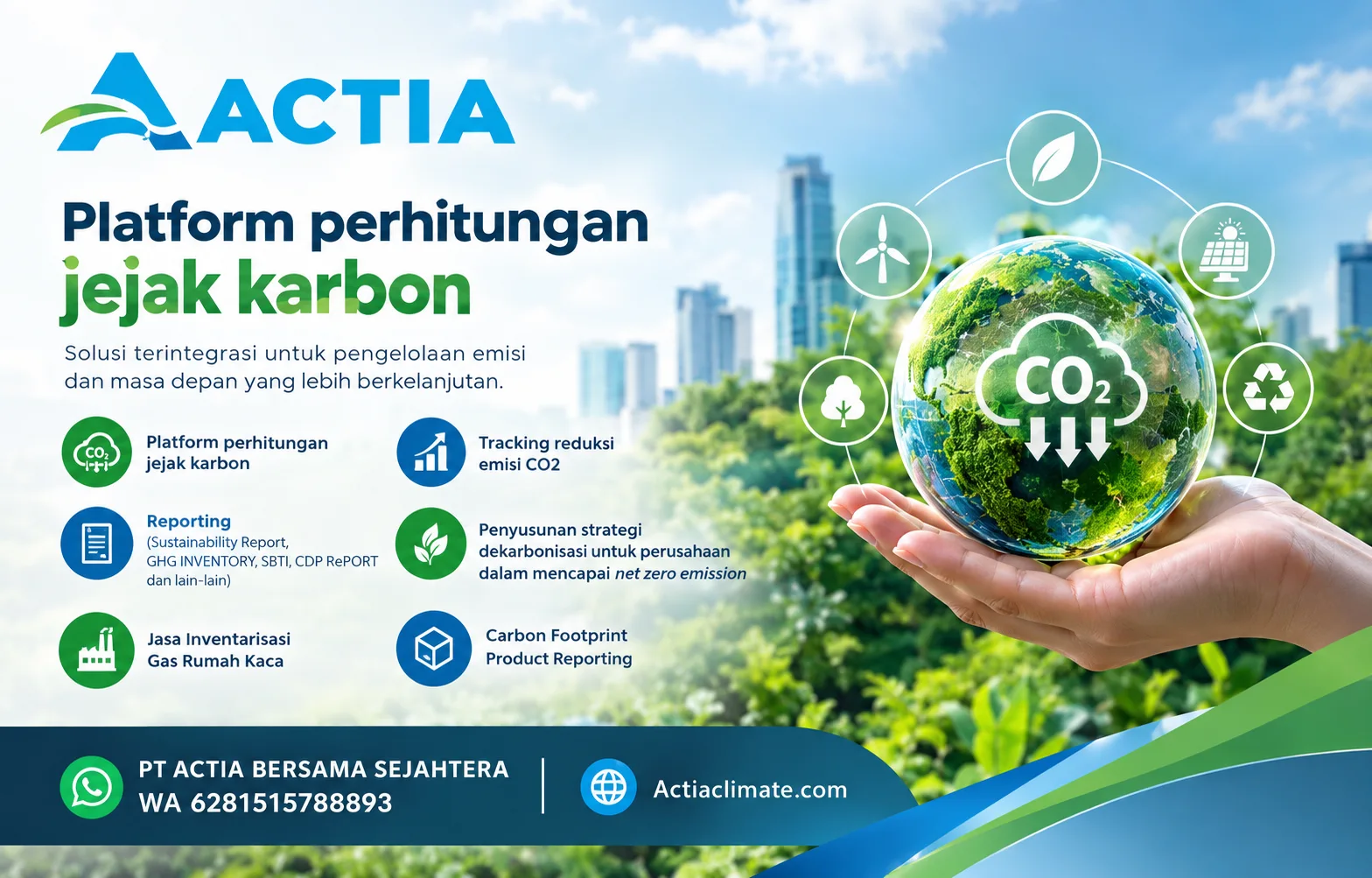
Actia Carbon Footprint Calculation Platform
The Actia Carbon Footprint Calculation Platform is designed to simplify greenhouse gas emissions management by helping businesses organize activity data and calculate emissions using relevant emission factors.
The platform supports companies seeking a structured approach to carbon accounting and emissions reduction planning.
Its intended applications include:
- Accessing emission factor references for relevant Scope 1, Scope 2, and Scope 3 activities.
- Identifying significant emissions sources and high-emission operational areas.
- Supporting emissions reduction planning using calculated activity data.
- Organizing emissions information for management review and sustainability reporting.
Digital calculation tools can improve workflow efficiency and reduce repetitive manual tasks.
However, software does not independently guarantee accurate emissions results. Activity data, calculation boundaries, emission factors, and assumptions must still be reviewed.
When combined with appropriate technical expertise, digital platforms can make ongoing carbon management more manageable for internal sustainability teams.
CO2 Emissions Reduction Tracking and Performance Monitoring
Once a company establishes an emissions baseline, consistent monitoring becomes essential for evaluating progress.
Emissions reduction tracking helps organizations identify changes in carbon performance and assess the results of operational improvements.
Actia’s carbon management approach supports the organization and review of historical emissions information.
- Analyze emissions patterns across reporting periods.
- Evaluate the effectiveness of energy efficiency and renewable energy initiatives.
- Identify operational activities that contribute significantly to emissions.
- Maintain historical data for internal evaluation and relevant reporting requirements.
For example, a company may compare emissions before and after replacing inefficient industrial equipment or implementing changes to transportation operations.
These comparisons should consider changes in business activity, production volume, reporting boundaries, and other factors that may influence emissions results.
Consistent monitoring helps management determine whether reduction measures are effective and where further improvement may be necessary.
Sustainability Reporting, GHG Inventory, SBTi, and CDP Support
Reliable emissions data provides important supporting information for corporate sustainability reporting.
Professional Carbon Footprint Consulting Services can assist companies in preparing emissions information for reporting frameworks and relevant stakeholder requirements.
Actia’s reporting-related services include:
- Preparation of sustainability reporting information using relevant GRI standards and applicable Indonesian OJK requirements.
- Development of greenhouse gas inventory documentation that can be reviewed against appropriate accounting standards.
- Technical assistance with information required for independent verification processes under ISO 14064-3.
- Advisory support for Science Based Targets initiative (SBTi) target-setting activities.
- Preparation of relevant emissions information for CDP environmental disclosures.
A sustainability report should communicate both achievements and challenges using transparent, documented information.
Reliable reporting also requires clear explanations of methodologies, reporting boundaries, assumptions, and significant data limitations.
Professional support can help organizations improve disclosure quality, but it does not automatically guarantee regulatory compliance, external assurance, or a particular ESG rating.
Developing a Corporate Decarbonization Strategy Toward Net Zero
Greenhouse gas measurement is the starting point for long-term emissions reduction planning.
After understanding its emissions profile, a company can develop a roadmap identifying practical steps toward its climate objectives.
Actia’s Carbon Footprint Consulting Services support businesses in evaluating decarbonization opportunities based on technical feasibility, investment requirements, and operational priorities.
Key activities include:
- Establishing an appropriate baseline year for measuring emissions performance.
- Preparing short-term, medium-term, and long-term decarbonization strategies.
- Evaluating investment opportunities in energy efficiency and low-carbon technologies.
- Identifying relevant renewable energy options and potential technology providers.
- Supporting the development of internal implementation and performance monitoring procedures.
Decarbonization initiatives may include equipment optimization, changes to production processes, renewable energy adoption, more efficient logistics, and supplier engagement.
Companies may also evaluate appropriate carbon credit arrangements as supplementary measures under relevant programs. These should not replace feasible direct emissions reductions.
A credible strategy should balance environmental objectives with technical capabilities, financial resources, and operational requirements.
Professional Greenhouse Gas Inventory Consulting Services
Actia supports businesses preparing greenhouse gas inventories across different operational and industrial environments.
The objective is to produce structured emissions information using appropriate methods and supporting evidence.
Our greenhouse gas inventory services cover:
- Assistance with collecting primary and secondary activity data from business departments.
- Technical guidance on suitable emissions calculation methods and uncertainty management.
- Identification of relevant emissions sources and potential improvement opportunities.
- Support for integrating carbon accounting findings with energy efficiency and reduction planning.
- Knowledge transfer and practical guidance for internal sustainability teams.
Companies may also need technical documentation prepared for independent verification or applicable registration requirements.
Formal third-party verification is distinct from consultancy support and should be conducted by an appropriately qualified verification body when required.
Our approach focuses on providing clear calculation methods and information that can be reviewed and understood by company representatives and relevant stakeholders.
Product Carbon Footprint Reporting and Life Cycle Assessment
Product carbon footprint assessments help businesses understand greenhouse gas emissions associated with a particular product or service.
This information may be important for manufacturers, exporters, and companies responding to sustainability-related requests from buyers and supply-chain partners.
Life Cycle Assessment (LCA) provides a systematic method for evaluating environmental impacts associated with a product over defined life-cycle stages.
These may include raw material extraction, manufacturing, transportation, product use, recycling, and end-of-life disposal.
Actia’s product-related carbon management support can help businesses:
- Assess greenhouse gas emissions associated with product life-cycle stages.
- Identify production processes and materials with significant emissions contributions.
- Evaluate opportunities for improving energy and material efficiency.
- Prepare product emissions information for relevant stakeholder requests.
- Support evidence-based environmental product communication and improvement planning.
Why Life Cycle Assessment Is Important
LCA can provide a broader understanding of environmental impacts than an assessment limited to direct operational emissions.
For example, a manufacturing business may discover that a significant part of a product’s environmental impact originates from raw material production rather than its own manufacturing facility.
With this information, product development and procurement teams can consider alternative materials, improve production methods, and evaluate more resource-efficient designs.
Recognized methodological references include ISO 14040 and ISO 14044 for LCA and ISO 14067 for product carbon footprint quantification.
A comprehensive LCA can require substantial supply-chain information and specialized expertise, but it may be conducted internally when an organization has suitable capabilities.
The value of professional consulting lies in methodological guidance, technical review, and support for complex data collection and interpretation.
SBTi Advisory Services and Science-Based Carbon Reduction Targets
The Science Based Targets initiative (SBTi) provides standards and guidance for companies seeking to establish greenhouse gas emissions reduction targets informed by climate science.
Developing these targets requires reliable emissions information, appropriate accounting boundaries, and an understanding of applicable target-setting criteria.
Professional Carbon Footprint Consulting Services can support businesses in preparing relevant information and evaluating possible reduction pathways.
Actia’s advisory approach may include:
- Reviewing the company’s existing greenhouse gas inventory.
- Assessing the completeness of emissions information needed for target setting.
- Evaluating suitable short-term and long-term emissions reduction pathways.
- Supporting preparation of technical information for applicable SBTi submissions.
- Developing a realistic decarbonization implementation roadmap.
- Evaluating the technical and financial feasibility of proposed reduction initiatives.
Formal SBTi target validation is subject to the initiative’s applicable assessment requirements. Professional advisory services do not automatically guarantee validation.
Corporate implementation also requires knowledgeable employees and consistent coordination between internal departments.
Actia provides relevant learning opportunities through its carbon economy, greenhouse gas inventory, and ESG training programs.
Environmental Monitoring Technology: Aeroqual S500 Indonesia
Environmental management may require field measurements in addition to corporate greenhouse gas accounting.
Ambient air quality monitoring enables organizations to measure selected pollutant concentrations at operating sites and other relevant locations.
Actia provides environmental monitoring equipment sales and rental support, including solutions involving the Aeroqual S500 portable air quality monitoring instrument.
The Aeroqual S500 can be configured with compatible sensor heads for selected air pollutant measurements, depending on the required monitoring parameters.
Potential applications include environmental assessments, periodic site inspections, and air quality monitoring programs.
Our equipment-related support may include:
- Sales and rental options for relevant ambient air quality monitoring instruments.
- Guidance on selecting appropriate sensor configurations.
- Support for routine monitoring and environmental assessment requirements.
- Technical guidance concerning instrument operation and calibration.
It is important to distinguish ambient air quality measurements from corporate greenhouse gas inventories.
Direct measurements of pollutant concentrations may contribute to environmental management activities, but they do not automatically determine an organization’s total greenhouse gas emissions.
Corporate emissions inventories require appropriate activity data, calculation methodologies, and emission factors.
Why Carbon Data Accuracy Is Essential
Reliable emissions accounting depends on the quality of the information used throughout the calculation process.
Incorrect activity data, unsuitable emission factors, and inconsistent reporting boundaries can affect greenhouse gas inventory results.
These inaccuracies may also influence sustainability disclosures and decarbonization planning decisions.
Professional Carbon Footprint Consulting Services can help companies establish appropriate data review and documentation procedures.
Using Relevant Emission Factors
Emission factors should be selected based on the activity being assessed, the geographic context, the relevant reporting methodology, and available technical information.
Depending on the project, suitable references may include IPCC guidance, Indonesian environmental guidelines, recognized emissions databases, and peer-reviewed academic literature.
A transparent inventory should document the sources of emission factors and explain important calculation assumptions.
Managing Data Quality and Uncertainty
Consultants may help organizations identify incomplete records, inconsistent datasets, or potential calculation errors.
Data quality reviews can improve the reliability of reported results and highlight areas requiring stronger internal procedures.
However, consultants should not be assumed to independently verify their own reports. Where external assurance is required, verification must follow the relevant standards and independence requirements.
Reducing Greenwashing Risks
Environmental claims should be supported by credible evidence and should accurately describe the organization’s actual performance.
Transparent emissions reporting can help businesses avoid misleading statements and communicate their sustainability progress more responsibly.
Companies should clearly explain reporting limitations, calculation assumptions, and whether emissions figures have undergone independent verification.
How to Choose the Right ESG and Carbon Footprint Consultant in Indonesia
Not all carbon consultants have the same technical expertise, sector experience, or reporting capabilities.
Before selecting a provider, businesses should evaluate whether the consultant understands their operational activities and intended assessment requirements.
Important selection criteria include:
- Relevant Experience: Experience preparing greenhouse gas inventories for similar industries and operating environments.
- Methodological Knowledge: Understanding of the GHG Protocol, ISO 14064, and relevant product carbon accounting methodologies.
- Data Management: Clear procedures for collecting, reviewing, documenting, and protecting business information.
- Reporting Capabilities: Ability to prepare suitable technical documentation for relevant disclosures and independent assessment.
- Technical Resources: Access to appropriate scientific references, emission factors, and calculation tools.
- Communication: Clear explanations of project scope, responsibilities, milestones, and expected deliverables.
- Capacity Building: Willingness to help internal employees understand the methodology and maintain useful procedures.
Project timelines should be realistic and reflect the complexity of the business, data readiness, and reporting requirements.
A reliable consultant should clearly distinguish between providing advisory services and performing independent third-party verification.
Businesses can explore Actia’s carbon footprint consulting and environmental management services to learn more about the available support.
Frequently Asked Questions About Carbon Footprint Consulting Services
1. How long does a corporate carbon footprint assessment take?
The duration depends on organizational size, operational complexity, emissions sources, and data availability. Some projects may take approximately four to twelve weeks, while more complex inventories or assessments involving extensive value-chain data may require additional time.
2. Do small and medium-sized businesses need Carbon Footprint Consulting Services?
Small and medium-sized businesses can benefit from carbon footprint consulting when responding to customer requests, participating in larger corporate supply chains, preparing sustainability disclosures, or identifying opportunities to improve resource efficiency.
Consulting requirements should be proportionate to the organization’s activities and objectives.
3. What is the difference between Scope 1, Scope 2, and Scope 3 emissions?
Scope 1 includes direct emissions from sources owned or controlled by a company. Scope 2 covers indirect emissions associated with purchased electricity and other acquired energy. Scope 3 includes other indirect emissions across the value chain, such as transportation, purchased goods, business travel, and waste.
4. Why should companies conduct a Life Cycle Assessment?
Life Cycle Assessment helps businesses evaluate environmental impacts associated with a product or service across defined life-cycle stages. It can support material selection, product design improvements, supply-chain evaluations, and evidence-based environmental disclosures.
5. How can a company begin working with a carbon consultant?
Companies can begin by identifying their reporting objectives, operating locations, reporting period, major activities, and available emissions-related records.
An initial consultation can help determine an appropriate work scope, data requirements, project responsibilities, and expected deliverables.
6. Is in-house carbon accounting always less expensive than hiring consultants?
Not necessarily. Internal assessments may reduce external consulting expenditure, but they still require employee time, technical knowledge, software, data collection, and quality review.
The overall cost depends on project complexity, internal capabilities, reporting requirements, and the amount of technical support required.
7. Can Carbon Footprint Consulting Services support sustainability reporting?
Yes. Professional consultants can assist organizations in preparing greenhouse gas inventory information, documenting calculation methods, reviewing supporting data, and organizing environmental metrics for relevant reporting frameworks.
8. Does hiring a consultant guarantee independent verification?
No. Consultancy and independent verification are different activities. Consultants can help prepare inventory documentation and support verification readiness, while formal independent verification must be conducted under the applicable verification requirements by an appropriately qualified body.
Carbon Footprint Consulting Services in Indonesia by Actia Climate
PT Actia Bersama Sejahtera supports businesses in Indonesia with greenhouse gas inventories, corporate carbon footprint calculations, digital carbon management tools, sustainability reporting assistance, and decarbonization strategy development.
With a presence in Jakarta and Surabaya, Actia provides technical guidance for organizations seeking more structured and reliable approaches to greenhouse gas management.
Whether your business is considering an in-house emissions assessment or requires professional support for a complex inventory, our team can help evaluate the appropriate approach.
Our Carbon Footprint Consulting Services are designed to help companies strengthen data quality, understand environmental performance, and identify practical emissions reduction opportunities.
We also support related needs, including SBTi advisory preparation, Life Cycle Assessment, carbon economy training, and environmental monitoring equipment.
Contact PT Actia Bersama Sejahtera to discuss your corporate greenhouse gas inventory, sustainability reporting, or decarbonization project.
WhatsApp: +62 815-1578-8893
Website: Actia Climate – Carbon Management and Environmental Consulting
Start building a reliable foundation for greenhouse gas accounting, environmental transparency, and long-term business sustainability with Actia Climate.