Get Ready to Pay Over IDR 1 Billion in "Carbon Tax" Per Year

Unless You Know How to Avoid It

Starting in January 2026, the European Union will officially implement the CBAM (Carbon Border Adjustment Mechanism)—also known as a “carbon border tax.” This means that for every tonne of steel, aluminum, or cement products you ship to Europe, you must pay a carbon fee based on the emissions price applicable there.

Current EU carbon price: €67 per tonne of CO₂. 2035 projection: could reach €200 per tonne of CO₂

For a steel company exporting 50,000 tonnes annually to Europe, this could mean a carbon bill of up to USD 20–40 million per year by 2034

Is your company ready?

If you are a Director, VP of Operations, or CFO at an Indonesian manufacturing company or exporter, here is the harsh reality you must face:
Many Indonesian companies have yet to calculate their potential CBAM costs, even though the obligations are already in effect. Ignorance is no legal defense—it is a financial risk.
CBAM requires you to report the actual emissions of each exported product. If emissions data is unavailable, the EU will use default values—which are significantly higher than your actual emissions. This means you pay more than necessary.
Carbon pricing is a combination of international law, emissions engineering, finance, and bureaucracy. No single department in your company is designed to handle this alone.
International consultants like SGS or LRQA focus solely on *technical verification*. They do not assist you in formulating a *business strategy*—such as calculating potential savings, negotiating with European buyers, or leveraging the domestic ETS to offset CBAM.

WHAT HAPPENS IF LEFT UNTREATED?

In 2023 alone, Indonesia’s steel exports to the European Union were valued at USD 904 million, and aluminum exports at USD 89 million. With CBAM in full effect, unprepared companies will face three adverse scenarios simultaneously:

1. Paying carbon costs is far more expensive than for competitors who are already prepared.

2. Loss of contract because European buyers chose a supplier with net-zero emission documentation.

3. Complete failure to export due to the lack of a CBAM account number, which is mandatory as of January 1, 2026.

This is not a future threat. It is happening right now!

ACTIA CARBON — INDONESIA’S FIRST AND MOST TRUSTED CBAM & ETS CONSULTANT

We do more than just help you pass audits. We help you turn carbon obligations into a competitive advantage in the European market.

What we do for you:

Calculate your CBAM exposure precisely.

You will know exactly how much to prepare, not just a rough estimate.

Prepare actual emission data recognized by the EU.

so that you pay the CBAM based on actual emissions, rather than default values ​​that inflate the bill.

Offset strategy via Indonesia's domestic ETS

Government Regulation No. 110/2025 opens up opportunities for domestic carbon credits that you can use to reduce CBAM costs.

Help register a CBAM account number.

Actia will also assist in preparing all documentation required by the EU.

Training Your Team

Actia is ready to train your internal team to independently manage carbon reporting in the future.

OUR SERVICE PACKAGES

Package

Service Scope

Suitable For

🟡 CBAM Ready Assessment CBAM exposure audit, potential cost calculation, emissions data gap analysis Companies wishing to first understand their current standing
🟠 CBAM Full Compliance All of the above + actual emissions data preparation + CBAM account registration + submission-ready report Active exporters to Europe needing immediate readiness
🔴 Carbon Strategy Suite All of the above + domestic ETS offset strategy + internal team training + 12-month advisory support Companies aiming to turn carbon pricing into a long-term competitive advantage

ACTIA is ready to help with your issues!

Actia Carbon is led by Mr. Dicky Edwin Hindarto, the only private consultant in Indonesia possessing the following combination of expertise:
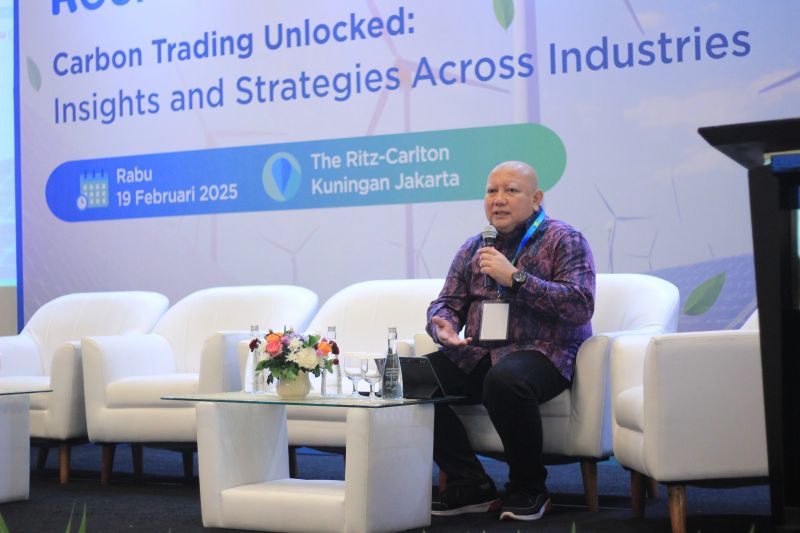

There is no other consultant in Indonesia who possesses this combination: **government experience + international negotiation + private-sector project implementation + large-scale corporate training** — all in a single person.
  • 16 years of hands-on experience in carbon pricing and carbon markets.
    Not theory, but real-world field experience ranging from the UNFCCC to industry projects.
  • Former Head of the JCM Secretariat & Head of the Carbon Trading Division at the National Council on Climate Change
    He built the system, rather than just studying it.
  • Served as Indonesia's Lead Negotiator for Carbon Markets at the UNFCCC.
    understanding global carbon regulations from the inside, not the outside
  • Has trained carbon teams at: Pertamina, PLN, Toyota Motor Manufacturing Indonesia, Pertamina Geothermal, OJK, Sarana Multi Infrastruktur, TUV Rheinland, and BRI.
    Indonesia’s largest clients have already placed their trust in him.
  • Specialized international ETS training
    from ICAP London (2015), the World Bank, the EU in Brussels (2014), and various international academies in over 20 countries

FAQ: Factory and Industrial Energy Audits

Yes. Starting January 1, 2026, ALL importers of steel, aluminum, cement, fertilizer, and hydrogen products into the EU are required to hold a CBAM account number and report emissions—with no exceptions based on volume. Those without an account number will not be able to bring goods into the EU.
CBAM is not a tax paid to the Indonesian government—it is a cost paid to the EU by *your importers in Europe*. However, indirectly, importers will pressure you to lower your selling price or opt for other suppliers with lower emissions. In short: you are the one who bears the impact.
The internal ESG team focuses on general sustainability reporting. CBAM requires highly specific expertise: product-level emissions MRV (Measurement, Reporting, and Verification) in accordance with EU standards, an understanding of the European ETS, and the CBAM registration mechanism. This is distinct and highly technical.
For the initial assessment: 2–4 weeks. For full compliance based on actual emissions data: 2–4 months, depending on the complexity of your production. The sooner you start, the lower the risk.
Yes. Companies that use actual emissions data (rather than default values) pay, on average, **significantly lower** CBAM costs. Coupled with carbon credits from Indonesia’s domestic ETS, there is a legal mechanism to reduce your CBAM costs.
Actia is the only firm that combines an understanding of both EU CBAM regulations and Indonesia’s domestic carbon regulations, backed by a track record with the UNFCCC and corporate training experience for clients such as Pertamina, PLN, and Toyota. International consultants lack insight into local dynamics, while other local consultants do not possess this level of international depth.
Currently, the ETS is mandatory for the power sector and is being expanded to other industries in accordance with Government Regulation No. 110/2025. Non-compliant companies risk facing sanctions and losing access to international carbon markets. It is better to be prepared now than to scramble later.

DON’T DELAY! EVERY DAY OF DELAY COMES AT A COST

CBAM is already in effect. Your competitors in Vietnam, Thailand, and India are moving quickly to comply. Companies that are ready earliest will secure premium pricing from European buyers and lock in long-term contracts. As for those who wait? They will end up paying high default values, losing contracts, and ultimately paying even more to catch up later.

No commitment required. Just 30 minutes with Mr. Dicky

You will discover:
  • The extent of your company’s CBAM exposure
  • The first steps to take
  • The potential savings you could achieve
CONTACT US NOW: info@actiacarbon.com